Enclomiphene
In brief
- Enclomiphene is not FDA-approved in the US or authorized for routine sale in the EU, but it may be available through research suppliers or some compounding pharmacies; in pharmacy or gray-market settings, it may be offered without a prescription, though this is not legally authorized for routine clinical use.
- Enclomiphene is used mainly for male secondary hypogonadism and sometimes off-label for male infertility. It is a selective estrogen receptor modulator (SERM) that helps stimulate the body’s own production of testosterone by increasing pituitary release of LH and FSH, which can support endogenous testosterone while preserving sperm production.
- The usual adult dose is 12.5–25 mg once daily, with 12.5 mg and 25 mg being the most common doses in studies; some sources also reference 50 mg tablets, but dosing should be individualized.
- It is available as an oral tablet, and in some limited settings as capsules or bulk powder for compounding/research use.
- It typically begins to work gradually over days to weeks, with hormonal changes often seen within 1–2 weeks and fuller clinical effects usually taking several weeks.
- The duration of action is approximately 24 hours per dose, which is why it is commonly taken once daily; treatment courses in studies often last 3–6 months with periodic reassessment.
- Alcohol should be avoided or limited, especially because both alcohol and enclomiphene can affect the liver and may worsen dizziness, mood changes, or gastrointestinal side effects.
- The most common side effects are hot flashes, headache, and nausea; mood swings/anxiety may also occur, and visual disturbances can happen less commonly.
- Would you like to try enclomiphene without a prescription?
Basic Enclomiphene Information
- INN (International Nonproprietary Name): Enclomiphene (also written as Enclomifene in some references)
- Brand names available in United States: Androxal
- ATC Code: G03X
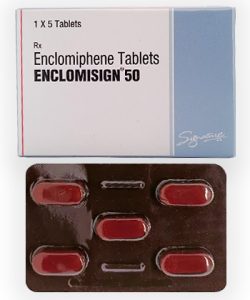
- Forms & dosages: Tablet 12.5 mg, 25 mg, 50 mg; capsule; bulk powder
- Manufacturers in United States: No FDA-approved manufacturer as of July 2025
- Registration status in United States: Investigational only
- OTC / Rx classification: Prescription-only (Rx) where under investigation
Enclomiphene At A Glance
Trying to understand enclomiphene without getting lost in forum talk and half-finished lab listings?
That is a fair place to start, because this medicine sits in a narrow space between reproductive endocrinology, fertility care, and a regulatory status that is still unsettled in the United States.
Enclomiphene is the purified trans-isomer related to clomiphene, and the practical reason people look for it is simple: support testosterone production while trying to avoid the sperm-suppressing effect seen with exogenous testosterone therapy.
As of July 2025, it remains investigational in the U.S., not FDA-approved, and not a routine over-the-counter product in any regulated market.
Everyday Use And Best Practices
Morning Vs. Evening Dosing
Most clinical protocols use daily dosing, commonly 12.5 to 25 mg for male secondary hypogonadism or infertility.
Staying with the same time each day helps build a steady enclomiphene daily use routine and makes it easier to notice whether your energy, libido, or mood is changing.
If a clinician does not prefer morning or evening, morning use is often easier to remember, especially when the day already has a built-in routine like breakfast or brushing your teeth.
Some people choose evening if they notice mild nausea or headache after taking enclomiphene tablets.
If a dose is missed, take it when remembered unless it is close to the next dose, and do not double up.
Taking With Or Without Meals
Real-world use is usually guided by tolerability rather than a strict food requirement.
If nausea shows up, taking the dose with a small meal can be easier on the stomach.
A simple checklist helps with practical dosing:
- Take the tablet at the same time each day.
- Use a small meal if nausea occurs.
- Drink enough water during the day.
- Keep a regular sleep schedule so mood and energy changes are easier to track.
- If you miss a dose, take it when remembered unless the next dose is close.
- Never take two doses at once to make up for a missed dose.
Those small habits can make a difference when you are trying to judge whether a treatment cycle is helping.
Safety Priorities
Who Should Avoid It
Safety comes first with enclomiphene, especially because the strongest data are still from clinical studies rather than broad commercial use.
Absolute contraindications from the product information include pregnancy (category X), liver disease, known hypersensitivity to enclomiphene or clomiphene analogues, active or past hormone-dependent tumors, and unexplained uterine bleeding if used in women.
It is also prescription-only where under investigation and not OTC in regulated markets.
People with pre-existing visual disturbances, hypertriglyceridemia, severe depression or psychiatric illness, or a history of thrombosis or thromboembolism need close clinician review before treatment starts.
Activities To Limit
Some symptoms deserve extra caution during treatment cycles.
- Be careful with driving or machinery if you notice blurred vision, spots, headache, or dizziness.
- Stop and call your clinician if mood changes, anxiety, or unusual symptoms appear.
- Report visual changes right away, even if they seem mild.
- Children have not been studied and are not recommended for use.
That is the kind of safety check that matters more than any online enclomiphene reviews.
Dosage And Adjustments
General Regimen
For male secondary hypogonadism and male infertility, the dose studied most often is 12.5 to 25 mg daily, with titration to effect.
Clinical protocols commonly run in 3 to 6 month treatment cycles, followed by periodic reassessment of symptoms and lab response.
Female infertility is not a standard use case, and routine use is not recommended based on the available data.
Special Cases
Older adults have no dedicated studies, so a lower starting dose may be sensible when comorbidities are part of the picture.
There are no formal dosing adjustments for renal impairment because the evidence is insufficient.
For hepatic impairment, avoidance is preferred when possible, or the drug should be used with extreme caution.
| Population | Typical Approach | Notes |
|---|---|---|
| Standard adult use | 12.5 to 25 mg daily | Most common in trials |
| Elderly patients | Consider a lower starting dose | No dedicated studies |
| Renal impairment | No formal adjustment data | Use caution |
| Hepatic impairment | Avoid if possible | Use extreme caution |
In trials, 12.5 mg and 25 mg tablets are most common, while capsules and bulk powder are limited or research-grade.
User Testimonials
Positive Reports
People searching for Androxal or enclomiphene tablets often describe better energy, improved libido, and reassurance that fertility may be better preserved than with testosterone replacement.
Those are common real-world themes, but they remain anecdotal and do not prove effectiveness for any one person.
Common Challenges
Common complaints include hot flashes, headaches, nausea, or mood swings.
Some buyers also worry about product legitimacy because most online supply is research-grade or compounded rather than FDA-approved.
| Reported Benefit | Reported Problem |
|---|---|
| Improved energy | Headache |
| Better libido | Nausea |
| Fertility support | Hot flashes |
| Preference over testosterone therapy | Mood swings |
Buying Guide
Pharmacy Sources
The key real-world fact is straightforward: there is no FDA-approved manufacturer in the United States as of July 2025.
Some compounding pharmacies may provide enclomiphene for research use only, not routine clinical use, and research or chemical suppliers such as Echemi and other global lab distributors are not standard patient pharmacy channels.
In our online pharmacy, enclomiphene is available without a prescription, with discreet delivery to United States in 5-14 days.
Price Comparison
When comparing enclomiphene price, look at source type, verification, batch documentation, and legal status before price alone.
Commercial packaging in the EU and Asia is very limited because of regulatory status, and gray-market offers for Androxal capsules or enclomiphene powder without documentation should raise a red flag.
- Confirm the source type.
- Ask for batch documentation.
- Review legal status before ordering.
- Avoid unlabeled powder listings.
- Do not rely on packaging quality alone.
What Is Inside And How It Works
Ingredients Overview
The INN is enclomiphene, and some references also spell it enclomifene.
The developmental and brand name most often seen is Androxal, and the CAS number is 15690-57-0.
Forms include tablet strengths of 12.5 mg, 25 mg, and 50 mg, plus capsules and bulk powder for compounding or research.
Mechanism Basics
Here is the simple version of the enclomiphene mechanism:
- It is the purified trans-isomer related to clomiphene.
- It is believed to stimulate endogenous testosterone production in men with hypogonadism.
- It may do that without suppressing sperm counts the way exogenous testosterone can.
That fertility-preserving angle is the main reason clinicians and patients keep looking at enclomiphene research.
Main Indications
Approved Uses
As of July 2025, enclomiphene is not FDA-approved and not approved in the EU, so there are no routine approved uses in regulated markets.
The main clinical interest remains investigational treatment of male secondary hypogonadism.
Off-Label Uses
Male infertility is the best-known off-label use in the available clinical studies, although evidence remains limited.
Female infertility is not a standard indication and is not recommended in the data provided.
| Category | Use Status | Notes |
|---|---|---|
| Investigational | Male secondary hypogonadism | Main clinical interest |
| Off-label | Male infertility | Limited evidence |
| Not recommended | Female infertility | Not a standard use case |
Interaction Warnings
Food Interactions
No specific food interactions are provided in the source data, so practical guidance stays focused on tolerability and consistent dosing.
If nausea appears, taking the dose with a small meal is a reasonable step.
Drug Conflicts
Review all medicines, supplements, and hormone-related therapies with a clinician, especially if there is concern for visual symptoms, thrombosis, mood changes, or liver issues.
- Tell your clinician if you use hormone therapy.
- Tell your clinician if you take supplements that affect hormones.
- Tell your clinician if you have a history of blood clots.
- Tell your clinician if you have liver concerns.
- Tell your clinician if you notice mood or vision changes.
Latest Evidence And Insights
What Current Clinical Interest Suggests
Interest in enclomiphene remains high because it may raise testosterone while better preserving sperm production than testosterone replacement.
That makes it especially relevant in male secondary hypogonadism and fertility-preserving strategies.
What The Evidence Cannot Yet Prove
Regulatory approval is still lacking in the United States, the EU, and the listed regional authorities as of 2025.
Most products seen online are clinical trial material or chemical supply-grade rather than market-authorized medicine.
| Evidence Area | Current Takeaway |
|---|---|
| Promising | Testosterone support with fertility preservation interest |
| Uncertain | Long-term real-world effectiveness across broader populations |
| Not established | Routine regulatory approval in major markets |
Alternative Choices
Closest Comparators
The closest enclomiphene alternatives are clomiphene, tamoxifen, and letrozole.
Clomiphene contains a mixture of isomers, while enclomiphene is the trans isomer thought to be more effective in men.
When Alternatives May Be Considered
Tamoxifen is mainly used in breast cancer, though it has some off-label overlap.
Letrozole works differently as an aromatase inhibitor and is used in male and female infertility.
The best choice depends on fertility goals, hormone labs, and side-effect tolerance.
| Drug | Main Use | Key Difference |
|---|---|---|
| Clomiphene | Female and male infertility | Mixture of isomers |
| Tamoxifen | Estrogen modulator | Primarily used in breast cancer |
| Letrozole | Infertility | Different mechanism |
Regulation Snapshot
US And International Status
In the U.S., enclomiphene is investigational only under FDA oversight, while the EMA and various national agencies do not have approval, and ANMDMR has no public records of approval as of July 2025.
Prescription-only applies where it is under investigation, and it is not OTC in regulated markets.
What This Means For Patients
Availability may be limited to clinical trials, research suppliers, or compounding settings labeled for research use only.
Androxal is best understood as a developmental or brand name rather than an approved retail product.
| Region | Status | Practical Meaning |
|---|---|---|
| United States | Investigational only | Not FDA-approved |
| European Union | Not approved | No marketing authorization |
| Romania, Moldova, EEU | No public records of approval | No market authorization |
Frequently Asked Questions
Common Questions
Is enclomiphene the same as clomiphene? It is related, but enclomiphene is the purified trans-isomer.
Is it approved in the US? No, it is investigational only as of July 2025.
What doses are commonly studied? 12.5 to 25 mg daily.
Can it affect fertility? It is often studied because it may preserve sperm counts better than testosterone therapy.
Practical Concerns
How should it be stored? Keep it at room temperature, 15 to 25°C or 59 to 77°F.
What should happen after a missed dose? Take it when remembered unless the next dose is close, and do not double the dose.
Guidelines For Proper Use
Daily Handling And Storage
Store enclomiphene at room temperature in a dry, dark place protected from heat, cold, moisture, and light.
When transporting it, use well-sealed packaging so humidity and light do not affect the product.
Monitoring And Follow-Up
Periodic reassessment is standard during the usual 3 to 6 month treatment cycle.
Watch for hot flashes, headache, nausea, mood swings, and vision changes, since those are the side effects most likely to surface in practice.
If an overdose is suspected, there is no specific antidote; supportive care is used while monitoring for nausea, vomiting, or vision changes.
- Do not change the dose without clinician input.
- Be extra careful if liver concerns are present.
- Report vision changes promptly.
- Call for help if severe symptoms occur.
Delivery Across United States
| City | Region | Delivery time |
|---|---|---|
| New York City | Northeast | 5-7 days |
| Los Angeles | West | 5-7 days |
| Chicago | Midwest | 5-7 days |
| Houston | South | 5-7 days |
| Phoenix | West | 5-7 days |
| Philadelphia | Northeast | 5-7 days |
| San Antonio | South | 5-9 days |
| San Diego | West | 5-7 days |
| Dallas | South | 5-7 days |
| San Jose | West | 5-9 days |
| Austin | South | 5-7 days |
| Jacksonville | South | 5-9 days |
| Fort Worth | South | 5-9 days |
| Columbus | Midwest | 5-9 days |