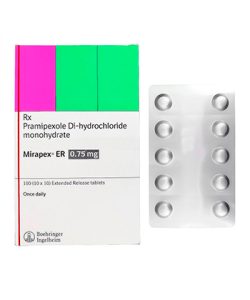
Mirapex
In brief
- Some online and local pharmacies may offer mirapex (pramipexole) for purchase without a prescription, with delivery options in many regions; however, pramipexole is prescription-only (Rx) in most countries and using it without medical supervision is not recommended—consult a healthcare professional before buying.
- Mirapex (pramipexole) is used to treat Parkinson’s disease and restless legs syndrome (RLS); it is a dopamine agonist that stimulates dopamine D2/D3 receptors to reduce motor symptoms and RLS sensations.
- Usual dosages: Parkinson’s — start 0.125 mg three times daily (IR) or 0.375 mg once daily (ER), titrate every 5–7 days up to a typical maximum of 4.5 mg/day; RLS — 0.125 mg once daily 2–3 hours before bedtime, titrate up to 0.5 mg/day as needed.
- Form of administration: oral tablets, available as immediate-release (IR) tablets and extended-release (ER) once-daily tablets.
- Onset time: immediate-release tablets begin to be absorbed within 30–90 minutes (peak around 1–3 hours); symptomatic improvement in RLS can occur within hours, while Parkinson’s symptom improvement may take days to weeks of titration.
- Duration of action: IR doses typically cover several hours (often 8–12 hours between doses), while ER formulations are designed to provide coverage for about 24 hours with once-daily dosing.
- Alcohol warning: avoid or limit alcohol—alcohol can increase drowsiness, dizziness, and the risk of orthostatic hypotension and impaired coordination when taken with pramipexole.
- The most common side effect is nausea.
- Would you like to try mirapex without a prescription?
Basic Mirapex Information
- INN (International Nonproprietary Name): Pramipexole.
- Brand Names Available In United States: Mirapex was the original brand; Mirapex tablets and Mirapex ER tablets are FDA approved but the Mirapex brand has been discontinued in the U.S.; generic pramipexole and pramipexole ER products are widely available.
- ATC Code: N04BC05.
- Forms & Dosages: Immediate‑release oral tablets in strengths including 0.088 mg, 0.125 mg, 0.18 mg, 0.25 mg, 0.35 mg, 0.5 mg, 0.7 mg, 0.75 mg, 1 mg, 1.05 mg and 1.5 mg; extended‑release (ER) oral tablets in 0.375 mg, 0.75 mg, 1.5 mg, 2.25 mg, 3 mg, 3.75 mg and 4.5 mg.
- Manufacturers In United States: Original innovator was Boehringer Ingelheim (Mirapex), with generics supplied by multiple manufacturers such as Teva and other global generic makers.
- Registration Status In United States: FDA approved for immediate‑release and extended‑release pramipexole formulations; generics are available while the Mirapex brand has been discontinued.
- OTC / Rx Classification: Prescription only (Rx).
Important: Follow your prescriber’s directions exactly; pramipexole is prescription‑only in the U.S. and most countries.
Storage: Store at room temperature (15–30°C) in original packaging, away from moisture and light.
Overdose Warning: Seek urgent care for signs of overdose such as confusion, severe dizziness, hallucinations, marked hypotension.
Behavioral Warning: Report new or worsening impulse‑control behaviors (gambling, hypersexuality) to your prescriber promptly.
Daily‑Life Tip: Use a pill organizer, align dosing with a routine (meals or bedtime), and set phone reminders when titrating.
Everyday Use & Best Practices
Morning Vs Evening Dosing
Worried about when to take your dose so it helps the most?
For Parkinson’s disease, immediate‑release pramipexole is commonly given three times a day (TID), often starting at 0.125 mg three times daily and titrating up as tolerated.
Extended‑release pramipexole lets many patients switch to once‑daily dosing, typically starting at 0.375 mg once daily for improved adherence and steadier control of motor symptoms.
For Restless Legs Syndrome, a single low immediate‑release dose (for example, 0.125 mg) taken 2–3 hours before bedtime is the usual approach to target nighttime symptoms.
- Quick dosing checklist: Start low and slow; align doses to symptom timing (morning/midday for PD motor control, single evening dose for RLS).
- Titration reminder: Increase IR PD dosing by 0.125 mg TID every 5–7 days as tolerated per prescriber instruction.
Taking With Or Without Meals
Will food change how pramipexole works?
Pramipexole may be taken with or without food, so dosing can usually fit into daily routines without strict meal timing.
If nausea happens during early titration, take your dose with a light snack to help reduce stomach upset.
Avoid heavy meals that consistently disrupt your dosing routine, and swallow ER tablets whole — do not crush them.
- Administration tips: Keep the ER tablet whole; for IR tablets, spacing doses evenly through the day helps maintain symptom control.
Safety Priorities
Who Should Avoid It
Are there people who should not take pramipexole?
Absolute contraindication: known hypersensitivity to pramipexole or any excipients in the product.
Relative precautions include severe renal impairment (dose adjustment required), a history of psychosis (dopamine agonists can worsen psychotic symptoms), active impulse‑control disorders such as pathological gambling or hypersexuality, and significant orthostatic hypotension.
Pregnancy and breastfeeding are generally avoided unless a prescriber determines benefits outweigh risks; pediatric safety has not been established.
Tell your prescriber about kidney problems, psychiatric history, and all medicines before starting.
Activities To Limit
What should patients avoid while adjusting to pramipexole?
Until you know how pramipexole affects you, avoid driving, operating heavy machinery, and other high‑risk activities due to possible drowsiness, sudden sleep episodes, dizziness, or hallucinations.
If daytime sleepiness or sudden‑onset sleep occurs, stop driving and inform your clinician immediately.
- Pre‑start screening checklist: Review renal function, psychiatric history, impulse‑control vulnerability, and blood pressure before initiation.
Dosage & Adjustments
General Regimen
What are typical starting doses and how do they change?
For Parkinson’s disease using IR tablets, a common start is 0.125 mg three times daily, with increases of 0.125 mg TID every 5–7 days as tolerated; the reported PD maximum is up to 4.5 mg/day.
Parkinson’s ER typically starts at 0.375 mg once daily and titrates according to response and tolerability.
For RLS, start with 0.125 mg once nightly 2–3 hours before bedtime and titrate every 4–7 days, commonly up to about 0.5 mg/day for most patients.
Always use the lowest effective dose for symptom control.
Special Cases
How do dosing rules change for older adults or people with kidney disease?
Elderly patients should start at lower doses and titrate more slowly because sensitivity increases and renal impairment is more common.
In renal impairment, start at reduced doses and lengthen titration intervals; severe impairment requires marked dose reduction under prescriber guidance.
Pediatric use is not established and is not recommended.
- Switching IR↔ER: Ask the prescriber for an equivalent daily dosing plan when converting between formulations to avoid overshoot or undertreatment.
- Missed dose rule: Take when remembered unless it’s near the next dose; do not double up.
User Testimonials
Positive Reports
Wondering whether it helps real people?
Many patients report improved motor control and reduced “off” time when pramipexole is started early in Parkinson’s or added to levodopa therapy.
Extended‑release options frequently receive praise for once‑daily convenience and more consistent symptom control compared with multiple IR doses.
People with RLS commonly note faster sleep onset and fewer nighttime leg discomfort episodes within days of starting a low dose.
Patient quote: “After switching to the ER tablet I sleep through the night and don’t have to think about midday doses.”
Common Challenges
What problems do people often run into?
Nausea during early titration, daytime drowsiness or sudden sleep attacks, vivid dreams or hallucinations in older adults, constipation, and dry mouth are commonly reported.
A smaller subgroup experiences impulse‑control disorders such as gambling or hypersexuality; family members often notice behavioral changes before patients do.
- PROs: Improved motor control, once‑daily ER convenience, effective RLS relief.
- CONs: Early nausea, sleepiness, potential for hallucinations or compulsive behaviors; may require dose adjustment or formulation change.
Buying Guide
Pharmacy Sources
Where can pramipexole be obtained in the U.S.?
Pramipexole is prescription‑only, but FDA‑approved generics for both IR and ER forms are widely available at retail pharmacies, mail‑order pharmacies, and online pharmacy platforms.
Manufacturers include the original innovator Boehringer Ingelheim and multiple generic makers such as Teva, Accord, Sandoz, Mylan, and others.
Ask the pharmacist for generics labeled “pramipexole” or “pramipexole ER” if cost is a concern.
Price Comparison
How much should patients expect to pay?
Prices vary by strength, quantity and whether IR or ER formulation is used; generics typically cost less than brand formulations.
Using insurance, pharmacy discount cards, or choosing mail‑order 90‑day supplies can lower out‑of‑pocket costs.
| Form | Typical Retail | Typical Generic |
|---|---|---|
| Immediate‑Release (per 30 tablets) | Varies by strength; generally higher than generic | Lower — ask pharmacist for price |
| Extended‑Release (per 30 tablets) | Higher for branded ER | More affordable with generic ER options |
Note: In our online pharmacy, mirapex is available without a prescription, with discreet delivery to United States in 5-14 days.
What’s Inside & How It Works
Ingredients Overview
What are the active ingredients and strengths?
The active ingredient is pramipexole (INN) in immediate‑release tablets across multiple small strengths and in ER tablets ranging from 0.375 mg to 4.5 mg.
Excipients vary by manufacturer; check the product leaflet if excipient allergies are a concern.
| Form | Common Strengths |
|---|---|
| IR Tablet | 0.088–1.5 mg (various increments) |
| ER Tablet | 0.375–4.5 mg |
Mechanism Basics
How does pramipexole help Parkinson’s and RLS?
Pramipexole is a dopamine agonist that stimulates D2/D3 receptors in the brain to replace dopaminergic activity that is reduced in Parkinson’s disease.
In Parkinson’s it reduces motor symptoms and helps decrease “off” time when combined with levodopa.
In RLS dopaminergic stimulation reduces uncomfortable leg sensations and improves sleep onset.
ER formulations provide steadier plasma levels, potentially reducing peaks and troughs and improving adherence.
Main Indications
Approved Uses
What conditions is pramipexole approved to treat?
FDA and EMA approvals cover Parkinson’s disease (as monotherapy for early PD or as adjunct therapy) and Restless Legs Syndrome (RLS).
Pramipexole is commonly used as a first‑line dopamine agonist in early Parkinson’s and as a monotherapy for symptomatic RLS relief.
Off‑Label Uses
Are there off‑label situations where clinicians prescribe it?
Occasional off‑label uses are clinician‑driven for certain movement disorder symptoms or sleep‑related complaints, but such use requires careful risk assessment because of psychosis and impulse‑control risks.
- Approved: Parkinson’s disease (IR/ER), Restless Legs Syndrome.
- Off‑Label: Select movement or sleep complaints at clinician discretion; pediatric use not recommended.
Interaction Warnings
Food Interactions
Does food change pramipexole’s effect?
No major food interactions are documented; pramipexole may be taken with or without food.
If the drug causes GI upset, taking it with a light snack can help.
Avoid alcohol because combined CNS depression may increase drowsiness and fall risk.
Drug Conflicts
Which drugs or drug classes interact with pramipexole?
Pramipexole can have additive sedative effects with other CNS depressants such as benzodiazepines, opioids and certain antihistamines.
It may exacerbate psychosis if combined with medications that increase dopaminergic tone in susceptible patients.
Because pramipexole is renally excreted, co‑prescription with agents that affect renal function or clearance requires monitoring and dose adjustment.
- Watch with: Other CNS depressants, dopaminergic agents, and drugs affecting renal elimination.
Latest Evidence & Insights
What do guidelines and recent clinical experience say?
Current guideline summaries and clinical experience support pramipexole as an effective dopamine agonist for early Parkinson’s disease and for RLS symptom control.
ER formulations (0.375–4.5 mg) provide once‑daily dosing that often improves adherence and smooths motor fluctuations compared with multiple daily IR doses.
Comparative choices among dopamine agonists (pramipexole, ropinirole, rotigotine) depend on side‑effect profiles, formulation preferences and patient comorbidities.
Long‑term monitoring should focus on impulse‑control disorders, sudden sleep episodes and hallucinations, especially in older adults and those with cognitive impairment.
| Comparator | Pros | Cons |
|---|---|---|
| Ropinirole | Oral dosing, familiar profile | Similar impulse‑control risk |
| Rotigotine Patch | Continuous delivery, useful if GI absorption is a concern | Skin site reactions possible |
Alternative Choices
What are the practical alternatives if pramipexole isn’t suitable?
Other dopamine agonists include ropinirole (oral), rotigotine (transdermal patch) and apomorphine injections for rescue therapy; bromocriptine is an older option.
Levodopa remains the most effective symptomatic therapy for PD but carries a higher long‑term risk of motor complications, so clinicians often balance age, activity level and side‑effect risk when choosing therapy.
For RLS alternatives include gabapentin enacarbil, pregabalin and iron supplementation if ferritin is low.
| Drug | Convenience | Key Side‑Effect Flag |
|---|---|---|
| Ropinirole | Oral, multiple strengths | Impulse‑control behaviors |
| Rotigotine | Patch, continuous delivery | Skin reactions |
Regulation Snapshot
Is pramipexole approved around the world?
Pramipexole is approved by major regulators including the FDA, EMA, TGA and Health Canada for Parkinson’s disease and RLS, with generics widely available.
The Mirapex brand has been discontinued in the U.S., but generics for IR and ER formulations are FDA‑approved and in distribution.
Manufacturing and distribution involve Boehringer Ingelheim as the original innovator and numerous generic manufacturers such as Teva, Accord, Sandoz, Mylan and others.
Practical takeaway: ensure prescriptions specify IR vs ER and exact strength to prevent pharmacy substitution errors.
| Region | Approval Status | Common Brand Names |
|---|---|---|
| United States | FDA approved (generics available; Mirapex brand discontinued) | Pramipexole generics |
| Europe | EMA and national approvals (Sifrol, Mirapexin) | Sifrol, Mirapexin, generics |
FAQ Section
Common Patient Questions
What are the short answers to the questions patients ask most?
Q: Can I stop pramipexole suddenly?
A: No — do not abruptly stop without consulting your prescriber; tapering may be needed to avoid withdrawal or worsening symptoms.
Q: What if I miss a dose?
A: Take as soon as remembered unless it’s near the next scheduled dose — do not double the dose.
Q: Can pramipexole cause gambling or hypersexuality?
A: Yes; impulse‑control disorders are known risks. Report new behaviors early to your prescriber or caregiver.
Quick Answers For Caregivers
What should caregivers watch for and do?
Monitor for sleep attacks, hallucinations, mood or behavior changes, falls and orthostatic symptoms.
Keep an up‑to‑date medication list and check pill bottles for exact strengths and whether a product is IR or ER.
When to call the provider: severe dizziness, sudden sleep episodes, new compulsive behaviors, hallucinations or signs of overdose such as severe drowsiness, confusion, or hypotension.
Guidelines For Proper Use
Practical Daily Rules
How should the medication be stored and managed everyday?
Keep pramipexole in its original packaging at room temperature (15–30°C), away from moisture and direct light, and avoid using past the expiry date.
Use a pill organizer if taking multiple medicines but verify each tablet against the blister before removing it, especially during titration.
Follow titration timelines: IR PD dosing commonly increases by 0.125 mg TID every 5–7 days; RLS titration usually every 4–7 days up to recommended limits.
Maximum PD dosing reported up to 4.5 mg/day; RLS typically up to 0.5 mg/day.
When To See Your Clinician
When should follow‑up and monitoring occur?
Schedule follow‑ups during titration and periodically for renal monitoring, behavioral assessment and evaluation of daytime sleepiness.
If experiencing severe side effects such as hallucinations, sudden sleep onset, severe dizziness or new compulsive behaviors, stop driving and contact the provider immediately.
Keep a symptom diary noting dose, timing, and symptoms to help clinicians adjust therapy effectively.
Delivery Across United States
| City | Region | Delivery Time |
|---|---|---|
| New York | Northeast | 5-7 days |
| Los Angeles | West | 5-7 days |
| Chicago | Midwest | 5-7 days |
| Houston | South | 5-7 days |
| Phoenix | West | 5-7 days |
| Philadelphia | Northeast | 5-7 days |
| San Antonio | South | 5-9 days |
| San Diego | West | 5-9 days |
| Dallas | South | 5-9 days |
| San Jose | West | 5-9 days |
| Austin | South | 5-9 days |
| Jacksonville | Southeast | 5-9 days |
| San Francisco | West | 5-9 days |
Closing Notes
Pramipexole (mirapex) is a well‑established dopamine agonist for Parkinson’s disease and Restless Legs Syndrome, available in immediate‑release and extended‑release oral formulations.
Use the lowest effective dose, follow titration schedules supplied by your prescriber, and monitor for drowsiness, behavioral changes and orthostatic symptoms.
Keep regular follow‑ups for renal monitoring and behavioral screening, and involve caregivers in watching for impulse‑control signs.
For price or product questions, ask a pharmacist about FDA‑approved pramipexole generics and ER options to find the most cost‑effective and convenient choice for your treatment plan.