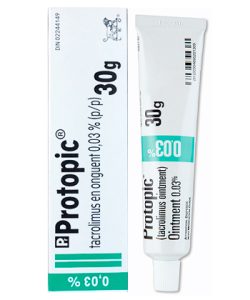
Protopic
In brief
- In many countries Protopic (tacrolimus ointment) is officially prescription-only, but availability varies: some brick-and-mortar pharmacies and online vendors may sell it without a prescription—check local regulations and vendor policies before purchase.
- Protopic is used to treat moderate-to-severe atopic dermatitis (eczema). It is a topical calcineurin inhibitor that reduces inflammation by blocking calcineurin-dependent T‑cell activation and cytokine release, providing a steroid-free alternative for sensitive areas like the face and eyelids.
- Usual dosages: apply a thin layer of 0.03% ointment twice daily for children aged 2–15; adults and adolescents ≥16 may use 0.03% or 0.1% ointment (0.1% usually for adults) applied twice daily until symptoms clear; maintenance can be once or twice weekly to previous lesions to reduce recurrences.
- Form of administration: topical ointment (tubes, e.g., 30g or 60g). Do not apply to mucous membranes, open wounds, or use under occlusive dressings.
- Onset time: some symptomatic relief (reduced itching/burning) can begin within days, with typical clearing of lesions often occurring within 1–3 weeks.
- Duration of action: effects persist while treatment is continued; maintenance regimens (once or twice weekly) can reduce relapses; long-term use has been studied for up to about 4 years in selected patients.
- Alcohol warning: avoid applying alcoholic/ethanol-containing products to treated skin and be aware that alcohol consumption or topical alcohol can sometimes cause flushing or increased skin sensitivity after application—minimize alcohol exposure on treated areas and limit sun/UV exposure.
- Most common side effec: burning or stinging at the application site (transient), plus redness, itching, and occasional folliculitis or viral skin infections.
- Would you like to try protopic without a prescription?
Basic Protopic Information
- INN (International Nonproprietary Name): Tacrolimus.
- Brand Names Available In United States: Protopic (ointment 0.03% and 0.1%).
- ATC Code: D11AH01 — Tacrolimus (topical calcineurin inhibitors).
- Forms & Dosages Sold In: Ointment 0.03% for children ≥2 years and adults, and ointment 0.1% for adults and adolescents ≥16 years, commonly in 30g or 60g tubes.
- Manufacturers In United States: Astellas Pharma is the original manufacturer; generic versions exist globally from companies such as Sandoz, Glenmark, Intas, and Cipla depending on market availability.
- Registration Status In United States: FDA-approved as a prescription-only treatment for moderate-to-severe atopic dermatitis in adults and children aged 2 years and older who have failed or cannot tolerate standard therapies.
- OTC / Rx Classification: Prescription only (Rx) in virtually all markets, not over-the-counter.
- Standard Dosages Per Condition: Adults — 0.03% or 0.1% ointment, thin layer to affected areas twice daily; Children 2–15 years — 0.03% ointment twice daily.
- Dosage Adjustments: Not approved for children under 2 years; no routine topical dose change in elderly or in hepatic/renal impairment, but use caution on very thin or extensively damaged skin.
- Typical Treatment Regimens: Apply twice daily during flares until clear (often within 1–3 weeks) and consider once- or twice-weekly maintenance to previously affected sites to reduce recurrence.
- Missed Dose / Overdose: Apply missed dose when remembered unless it is near the next dose; do not double doses; systemic overdose is unlikely with topical use.
- Storage & Transport Guidelines: Store below 25°C, do not freeze, keep tube tightly closed and protected from light, and check package insert for shelf life instructions.
- Absolute Contraindications: Known hypersensitivity to tacrolimus or ointment excipients such as mineral oil or paraffin, active skin infections, or compromised immune systems (post-transplant, HIV, or on systemic immunosuppressants).
- Relative Contraindications / Monitoring: Use caution with a personal or family history of skin cancer or premalignant lesions, and minimize sun/UV exposure on treated areas.
- Common Side Effects: Very common local reactions include transient burning or stinging, itching, erythema, flushing, and skin tingling; less common effects include folliculitis and herpes simplex flares.
- Competitors: Elidel (pimecrolimus), topical corticosteroids (hydrocortisone, betamethasone), and crisaborole (Eucrisa) are alternative topical options for atopic dermatitis.
- Word-Use Cases: Examples include “Buy Protopic ointment online,” “Tacrolimus ointment 0.1% for eczema,” and “Tacrolimus 0.03% ointment for children.”
- Additional Useful Information: Protopic is steroid-free and has less risk of skin thinning than corticosteroids, it should not be applied to mucous membranes or open wounds, and it is not routinely recommended in pregnancy or lactation unless benefits outweigh risks.
Morning Vs Evening Dosing
Which time of day works best for your routine is fine—there is no proven difference in absorption tied to morning versus evening dosing with topical tacrolimus.
Many patients choose to apply Protopic after a morning shower and again just before bedtime to build a consistent routine that helps adherence.
Because Protopic is an ointment, allow it to absorb before dressing to reduce transfer to clothing and linens.
Avoid applying immediately before heavy exercise or activities that cause sweating to minimize spread and irritation.
For sensitive areas like the face or eyelids, clinicians often recommend evening application first to test tolerance before expanding to larger areas.
Protopic ointment may be used twice daily during flares and discontinued when the skin clears, which helps limit unnecessary exposure.
For maintenance, many clinicians advise once- or twice-weekly application to previously affected sites to prevent relapse.
Taking With Or Without Meals
Because tacrolimus ointment is applied to the skin, what you eat does not affect how it works and there are no meal-related restrictions.
Do not ingest the ointment; systemic absorption with normal topical use is minimal.
If you accidentally swallow a small amount, contact a clinician or poison control for guidance, but systemic toxicity is unlikely from topical ointment.
Keep topical tacrolimus away from mucous membranes and do not apply to the mouth, eyes, or open wounds.
Storage advice: store tubes below 25°C, keep the cap closed, and check expiration dates printed on the packaging.
Everyday Use Checklist
- Wash and gently dry the affected area before applying a thin layer of Protopic ointment.
- Apply only to lesions and avoid healthy surrounding skin when possible.
- Allow ointment to absorb before dressing and avoid occlusion unless instructed by a clinician.
- Use twice daily for flares, and stop when the skin clears; consider once- or twice-weekly maintenance to prior lesions.
- Store below 25°C and keep tube tightly closed.
Don’ts
- Do not apply to open wounds, mucous membranes, or actively infected skin.
- Do not use under occlusive dressings unless a clinician directs otherwise.
- Avoid direct UV exposure on treated areas and don’t use tanning beds while using tacrolimus ointment.
- Do not ingest the ointment; topical use only.
Who Should Avoid It
Protopic is not appropriate for everyone and is prescription-only in the United States, so a clinician visit is required to confirm suitability.
Do not use tacrolimus ointment if you have known hypersensitivity to tacrolimus or any ointment excipients such as mineral oil or paraffin.
Patients with compromised immune systems, such as post-transplant recipients, people with HIV, or those on systemic immunosuppressants, should avoid Protopic unless closely supervised by a clinician.
Active skin infections—bacterial, viral (including herpes simplex and varicella), or fungal—are contraindications for application until the infection is controlled.
Discuss use with a clinician if you or close relatives have a history of skin cancer or premalignant lesions because labelled warnings call for individual risk assessment.
Activities To Limit
Limit sun and UV exposure on treated skin and avoid tanning beds while using topical tacrolimus.
Cover treated areas or use sunscreen as recommended by your clinician to protect against ultraviolet light.
Avoid applying alcohol-based skin products immediately after Protopic application because they may increase irritation.
Do not apply tacrolimus ointment under occlusive dressings unless instructed by a clinician.
If treating eyelid or near-eye areas, use extra care to prevent ocular exposure and consult your clinician about safe application techniques.
| Contraindication | Reason |
|---|---|
| Known hypersensitivity to tacrolimus or excipients | Risk of allergic reaction to active drug or mineral oil/paraffin base |
| Immunocompromised patients | Theoretical increased risk; labelled caution |
| Active skin infections | May worsen infection or delay healing |
| Pregnancy/Breastfeeding | Not routinely recommended unless clinician determines benefit outweighs risk |
General Regimen
Apply a thin layer of Protopic ointment only to affected skin twice daily during flare-ups until the skin clears, which commonly occurs within 1–3 weeks.
Adults may use either the 0.03% or 0.1% formulation depending on clinician choice and disease severity.
Children aged 2 to 15 years should use the 0.03% concentration only.
After clearing, many clinicians recommend a maintenance strategy of once- or twice-weekly application to previously affected sites to reduce recurrences.
If you miss a dose, apply as soon as you remember unless it is near the time of the next dose—do not double up.
Special Cases
Children under 2 years are not approved for Protopic use and safety has not been established in that age group.
Elderly patients generally use the same topical regimen as adults but should be monitored for increased skin sensitivity due to age-related changes in skin barrier function.
Hepatic or renal impairment does not normally require topical dose adjustment because systemic exposure is minimal with proper topical use.
Use extra caution on very thin, broken, or extensively damaged skin because systemic absorption can increase in those situations.
| Age Group | Formulation | Frequency |
|---|---|---|
| Children 2–15 years | 0.03% ointment | Thin layer to affected area twice daily |
| Adolescents ≥16 years | 0.1% ointment (or 0.03% per clinician) | Thin layer twice daily |
| Adults | 0.03% or 0.1% ointment | Thin layer twice daily; maintenance once–twice weekly as advised |
Missed Dose And When To Call Clinician
Apply a missed dose when remembered unless the next scheduled dose is near; do not apply extra ointment to make up for a missed dose.
Call your clinician if you experience severe or prolonged burning, worsening skin infection, new systemic symptoms, or if you are immunocompromised and considering use.
Positive Reports
Many patients report a rapid reduction in itching and visible inflammation within days to a couple of weeks after starting Protopic.
Patients frequently note that tacrolimus ointment is especially useful in steroid-sensitive areas like the face and eyelids because it is steroid-free and avoids skin thinning.
Users appreciate its role as a maintenance option that can reduce reliance on topical corticosteroids over time.
Common Challenges
Transient burning or stinging at the application site is the most commonly reported adverse effect and often lessens after several days of use.
Mild redness or tingling can occur, and less commonly users report folliculitis or flares of cold sores in treated regions.
Some patients find the ointment texture greasy, which can affect cosmetic acceptance on visible areas.
Patient Tips
- Start on a small area to gauge local tolerance before applying to larger surfaces.
- Cool inflamed skin gently before application to reduce burning sensations.
- Use emollients to support barrier repair, applying them at different times than Protopic to avoid dilution.
- If stinging is severe or persistent, stop the ointment and contact your clinician.
| Pros | Cons |
|---|---|
| Steroid-free, less risk of skin atrophy | Common transient burning or stinging |
| Effective for sensitive areas and maintenance | Ointment texture may feel greasy |
Pharmacy Sources
Protopic is prescription-only in the United States, so a clinician visit is required to obtain an Rx for tacrolimus ointment.
Branded Protopic is marketed by Astellas Pharma, and generic tacrolimus ointments may be supplied by manufacturers such as Sandoz or other global firms depending on availability.
Verify that any pharmacy you use is licensed and follows safe shipping and storage practices to ensure product integrity.
In our online pharmacy, protopic is available without a prescription, with discreet delivery to United States in 5-14 days.
Price Comparison
Cost varies by brand versus generic, tube size (commonly 30g or 60g), and insurance coverage or manufacturer assistance programs.
Compare local pharmacy cash prices, reputable online pharmacy quotes, and any manufacturer savings plans from Astellas for possible discounts.
Avoid unverified online sellers and check for lot numbers and cold-chain or storage assurances during shipment.
| Product | Form | Common Tube Sizes | Price Range (Approx.) |
|---|---|---|---|
| Protopic (Astellas) | Ointment 0.03%, 0.1% | 30g, 60g | Varies by pharmacy and insurance |
| Tacrolimus Generic (Sandoz, others) | Ointment 0.03%, 0.1% | 30g, 60g | Often lower than brand |
Ingredients Overview
The active ingredient in Protopic is tacrolimus at either 0.03% or 0.1% strength in an ointment base.
Common excipients in the ointment base include mineral oil and paraffin; check your product leaflet for the full excipient list in your country.
Because it is an ointment, expect an emollient, occlusive texture that helps with skin barrier repair but may feel greasy.
Mechanism Basics
Tacrolimus is a topical calcineurin inhibitor that works at the cellular level by blocking calcineurin in T cells and reducing cytokine release that drives inflammation in atopic dermatitis.
Being steroid-free, tacrolimus reduces the risk of skin atrophy compared with topical corticosteroids and is therefore useful on delicate skin areas like the face and eyelids.
Systemic absorption is typically minimal with normal topical use, although absorption can increase on very damaged or large areas of skin.
| Component | Role |
|---|---|
| Tacrolimus | Active anti-inflammatory agent; topical calcineurin inhibitor |
| Mineral Oil / Paraffin | Ointment base excipients that provide occlusion and emollient effect |
Approved Uses
Protopic (tacrolimus ointment) is approved for moderate-to-severe atopic dermatitis in adults and children aged 2 years and older who have not responded to or cannot tolerate conventional therapies.
The 0.03% formulation is indicated for children two years and older and adults, while 0.1% is indicated for adults and adolescents 16 years and older in many markets.
Off-Label Uses
Clinicians sometimes use topical tacrolimus off-label for other inflammatory skin conditions such as localized lichen planus, certain cases of vitiligo as an adjunct to repigmentation strategies, or seborrheic dermatitis in sensitive areas, though evidence and regulatory status vary.
Always discuss off-label use with your dermatologist to ensure an appropriate risk-benefit assessment for your situation.
| Approved Indication | Common Off-Label Considerations |
|---|---|
| Moderate-to-severe atopic dermatitis (≥2 years) | Local inflammatory dermatoses such as lichen planus, vitiligo adjunct |
Food Interactions
There are no food interactions with topical tacrolimus, so you do not need to change meals or diet when using Protopic.
Drug Conflicts
Systemic drug interactions from topical tacrolimus are rare because systemic absorption is generally minimal with proper topical use.
Exercise caution if you are taking systemic immunosuppressants or systemic tacrolimus, and discuss with your clinician because systemic levels could theoretically rise if very large or extensive areas are treated or if skin is significantly compromised.
Do not combine tacrolimus ointment with other topical immunosuppressants such as pimecrolimus unless directed by a clinician.
Interaction Checklist
- Tell your clinician about any systemic immunosuppressants or topical immunomodulators you use.
- Inform your clinician about active skin infections before starting tacrolimus ointment.
- Discuss vaccines and timing with your healthcare provider if you have concerns about local application over vaccination sites.
Recent Findings Summary
Clinical studies support tacrolimus ointment’s efficacy in moderate-to-severe atopic dermatitis with maintenance regimens (once or twice weekly) that reduce recurrence risk.
Long-term safety data exist for selected studies up to several years with ongoing monitoring in clinical practice.
Local adverse effects such as burning or stinging are common but usually transient, and tacrolimus is steroid-sparing with a lower risk of skin atrophy compared with corticosteroids.
Practical Takeaways
- Use Protopic as part of a comprehensive eczema plan that includes moisturizers and trigger avoidance.
- Monitor treated areas for persistent irritation, infection, or unusual lesions.
- Discuss theoretical malignancy warnings with your dermatologist, especially if immunocompromised or with a history of skin cancer.
Comparable Meds
Topical corticosteroids such as hydrocortisone and betamethasone remain first-line for many flares and are often used before or alongside tacrolimus in treatment plans.
Pimecrolimus (Elidel) is another topical calcineurin inhibitor with similar uses, and crisaborole (Eucrisa) is a non-steroidal PDE4 inhibitor option for mild-to-moderate eczema.
When To Consider Switching
Consider switching therapies if you have inadequate clinical response after an appropriate trial, intolerable local side effects, development of infection at the treatment site, or new medical contraindications such as emerging immunosuppression.
Discuss cost, coverage, and patient preference with your clinician when weighing alternatives like topical steroids, pimecrolimus, or crisaborole.
| Drug | Class | Main Pros | Main Cons |
|---|---|---|---|
| Protopic (tacrolimus) | Topical calcineurin inhibitor | Steroid-sparing, good for sensitive areas | Local burning common, ointment texture |
| Elidel (pimecrolimus) | Topical calcineurin inhibitor | Alternative non-steroidal option | Similar local tolerability issues |
| Topical Corticosteroids | Corticosteroid | Rapid anti-inflammatory effect | Risk of skin atrophy with prolonged use |
Approval & Availability
Protopic is FDA-approved in the United States for moderate-to-severe atopic dermatitis in adults and children aged two and older and is prescription-only.
Generic tacrolimus ointments are available from various manufacturers in some markets, but brand and generic presence varies by country and pharmacy.
Prescription Status
Tacrolimus ointment requires a prescription in virtually all markets, and you should verify pharmacy licensing before purchasing online.
Follow storage rules on shipment—store below 25°C, do not freeze, and check expiry and post-opening shelf-life in the leaflet.
| Country/Agency | Status | Typical Strengths |
|---|---|---|
| United States (FDA) | Rx only; approved for ≥2 years | 0.03%, 0.1% ointment |
| European Union (EMA) | Rx only; indicated from age 2 | 0.03%, 0.1% ointment |
Quick Answers
- Can children use Protopic? Yes, 0.03% is approved for children aged 2 years and older.
- Is tacrolimus a steroid? No, it is a topical calcineurin inhibitor and is steroid-free.
- Can I use it on my face? Yes, Protopic is commonly used for sensitive facial areas under clinician guidance.
- How long until it works? Many people see improvement within 1–3 weeks.
When To Call A Clinician
- Persistent or worsening skin infection at the treated site.
- Severe or prolonged burning, stinging, or irritation after application.
- New systemic symptoms such as fever or unexplained malaise.
- If you are immunocompromised, pregnant, or breastfeeding before starting treatment.
Step-By-Step Application
Wash and gently dry the affected area before applying tacrolimus ointment.
Squeeze a thin layer and apply only to lesions—avoid healthy surrounding skin when possible.
Rub in gently until absorbed and avoid occlusive dressings unless directed by a clinician.
Wash hands after application unless you are treating the hands themselves.
If using emollients, consider applying them at a different time to avoid diluting the topical tacrolimus.
Storage & Travel Tips
Keep the tube below 25°C, cap tightly, and keep the original packaging for storage instructions and expiry information.
Many products list a typical unopened shelf life around three years and about 12 months after opening, but verify the leaflet for your pack.
For travel, carry tacrolimus ointment in its original box with prescription documentation and avoid exposing it to extreme heat.
- Application Steps Checklist: Clean skin, thin layer to lesions, gentle rub-in, avoid occlusion, wash hands.
- Travel Packing Table: Temperature — keep below 25°C; Documentation — carry Rx; Emergency Contacts — keep clinician/clinic phone.
Delivery Across United States
| City | Region | Delivery Time |
|---|---|---|
| New York | New York | 5-7 days |
| Los Angeles | California | 5-7 days |
| Chicago | Illinois | 5-7 days |
| Houston | Texas | 5-7 days |
| Phoenix | Arizona | 5-7 days |
| Philadelphia | Pennsylvania | 5-7 days |
| San Antonio | Texas | 5-7 days |
| San Diego | California | 5-7 days |
| Dallas | Texas | 5-7 days |
| San Jose | California | 5-7 days |
| Austin | Texas | 5-7 days |
| Jacksonville | Florida | 5-9 days |
| Cleveland | Ohio | 5-9 days |
| Minneapolis | Minnesota | 5-7 days |
| Denver | Colorado | 5-7 days |