Rogaine
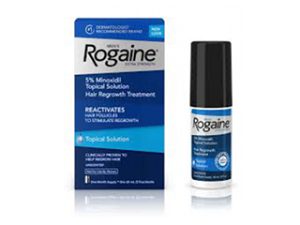
In brief
- You can buy Rogaine without a prescription in many pharmacies and online stores, since topical minoxidil is generally OTC in the United States and many other countries. Oral minoxidil is prescription-only.
- Rogaine is used for androgenetic alopecia, or pattern hair loss, in men and women. Its active ingredient, minoxidil, helps stimulate hair follicles and prolong the growth phase of hair; it was originally developed as a blood pressure medicine.
- The usual dose is 1 mL of 2% or 5% topical solution applied twice daily, or half a capful of 5% foam applied twice daily. Do not use more than directed.
- The form of administration is topical solution or topical foam applied to the scalp.
- It usually does not work immediately; visible improvement may take 4 to 6 months of regular use.
- To maintain results, it must be used continuously. If you stop using it, new hair growth may be lost within about 3 to 4 months.
- Do not drink alcohol with topical Rogaine; alcohol is not a major direct interaction, but excessive drinking may worsen dizziness or dehydration in sensitive users. Avoid alcohol if you are using oral minoxidil unless your doctor says it is safe.
- The most common side effects are scalp irritation, dryness, redness, itching, flaking, and temporary increased shedding at the start of treatment.
- Would you like to try Rogaine without a prescription?
Basic Rogaine Information
- INN (International Nonproprietary Name): Minoxidil
- Brand names available in United States: Rogaine, Kirkland Signature, Equate Hair Regrowth Treatment, Minoxidil extra strength
- ATC Code: D11AX01; C02DC01 for systemic antihypertensive use
- Forms & dosages: 2% and 5% topical solution; 5% topical foam; oral tablets 2.5 mg and 10 mg
- Manufacturers in United States: Kenvue Brands, Perrigo, Aurobindo Pharma, Taro, Apotex, Teva, Sun Pharma, Watson Labs, Pfizer, Bausch & Lomb, Hikma
- Registration status in United States: FDA-approved OTC for topical use; oral minoxidil is Rx-only
- OTC / Rx classification: Topical minoxidil is OTC; oral minoxidil is prescription only
Everyday Use & Best Practices
Trying to fit Rogaine into a busy day usually comes down to one question: morning, evening, or both?
The practical answer is consistency.
For topical minoxidil, the standard routine is 1 mL of 2% or 5% solution twice daily, or half a capful of 5% foam twice daily.
That schedule works best when it matches real life, like applying after a morning shower, then again at night before bed, or splitting doses around work and styling time.
If mornings are rushed, evening dosing may be easier to stick with.
If your scalp routine includes blow-drying or heavy styling, plan the application when the scalp can stay dry long enough for the product to absorb fully.
Topical minoxidil is not taken with meals because it is applied to the scalp, not swallowed.
That also means there is no food timing issue the way there is with oral medicines.
- Apply to a dry scalp.
- Use the labeled amount only.
- Let it dry completely before styling.
- Avoid washing the area right after application.
- Stay with the same daily routine so doses are not missed.
Visible regrowth may take 4 to 6 months, and stopping can reverse gains within 3 to 4 months.
Safety Priorities
Some people should think twice before starting minoxidil foam or minoxidil solution.
The biggest practical warning signs are a known allergy to minoxidil or to the product ingredients, plus any scalp area that is already irritated or broken.
- Avoid use on open wounds, sunburn, scalp infection, or active scalp dermatoses.
- Use extra caution in pregnancy or while breastfeeding, because safety is not established in pregnancy.
- People with cardiovascular disease should be careful, since systemic absorption risk can matter more in that setting.
- Thin or very sensitive skin may also be more prone to irritation or absorption.
Everyday habits can get in the way too.
Swimming soon after application, heavy sweating, sleeping before the product dries, or putting on styling products too early can all reduce how well the treatment fits into a scalp routine.
Using more than directed does not speed up results.
It can increase scalp irritation and, rarely, systemic side effects.
Oral minoxidil is different.
It is prescription only and has a separate risk profile, including fluid retention and tachycardia.
Dosage & Adjustments
The standard topical regimen for androgenetic alopecia is straightforward.
Adults generally use 1 mL of 2% or 5% topical solution twice daily, or half a capful of 5% foam twice daily.
In the U.S., topical minoxidil is an OTC hair loss medication used mainly for androgenetic alopecia in men and women.
Results are usually assessed after 4 to 6 months, and treatment is often long-term or indefinite to keep the gains.
| Situation | Topical Use | Practical Adjustment |
|---|---|---|
| Children under 18 | Not recommended | Use is not advised for topical minoxidil. |
| Older adults | Usually no specific dose change | Watch for skin sensitivity and thin-skin absorption. |
| Liver or kidney impairment | Use caution | Extra care is needed if systemic exposure is a concern. |
| Oral minoxidil | Rx-only tablets | Used for severe hypertension, not standard self-care for hair loss. |
That oral form is commonly discussed as 2.5 mg or 10 mg tablets, but those are clinician-managed products for severe hypertension, not routine hair loss treatment.
For topical use, the main goal is steady application, not bigger amounts.
User Testimonials
People trying Rogaine reviews often talk about the same few experiences.
Many like the foam because it is easier to use, dries faster, and feels less messy than a liquid dropper bottle.
Some users feel calmer when early shedding slows down, since that can be a sign the routine is at least being followed consistently.
Gradual filling-in at the crown or hairline is another common patient-centered report, but it tends to happen slowly.
- Common positives: easier daily use with foam, less anxiety about shedding, and slow improvement over months.
- Common challenges: scalp dryness, itching, flaking, the frustrating initial shed, and disappointment when doses are skipped.
- Realistic expectation: hair regrowth results vary, and visible change usually takes months rather than weeks.
That slow timeline is important because minoxidil shedding can worry people who were hoping for quick wins.
Consistency matters more than brand hype, and that is true whether the bottle says Rogaine or another minoxidil foam or solution label.
Buying Guide
Shoppers in the U.S. usually find buy Rogaine options at drugstores, big-box retailers, and online pharmacies.
Common choices include branded Rogaine, Kirkland Signature minoxidil, and Equate minoxidil.
Packaging often comes as multi-bottle monthly kits, foam canisters, or dropper bottles, depending on whether the shopper prefers foam or solution.
| Brand | Form | Shopping Consideration |
|---|---|---|
| Rogaine | Solution or foam | Well-known brand with men’s and women’s options. |
| Kirkland Signature | Solution or foam | Often chosen for value and multi-month kits. |
| Equate Hair Regrowth Treatment | Solution or foam | Common retail-label option for shoppers comparing price. |
| Generic minoxidil | Solution or foam | Widely available because the patent has expired. |
Price comparison should go beyond sticker price.
Check concentration, whether it is foam or solution, and how many months the kit covers.
Before checkout, verify the seller, the expiration date, and that the product is OTC in the U.S.
In our online pharmacy, rogaine is available without a prescription, with discreet delivery to United States in 5-14 days.
What’s Inside & How It Works
What exactly is in Rogaine, and why does it help hair?
The active ingredient is minoxidil, which is the INN used around the world.
Topical products come as 2% or 5% solution and 5% foam.
Rogaine is just one of several global brand names for the same active drug.
| Form | Strength | Common Use |
|---|---|---|
| Topical solution | 2% or 5% | Hair loss treatment for androgenetic alopecia |
| Topical foam | 5% | Hair regrowth treatment for men and women |
| Oral tablet | 2.5 mg or 10 mg | Severe hypertension, prescription only |
Minoxidil was originally developed as an oral antihypertensive, and hair growth was noticed as a side effect.
For everyday use, the important part is simple biology: it helps extend the growth phase of hair follicles, which may support thicker-looking hair over time.
For classification, it is listed under D11AX01 for hair loss treatment and C02DC01 when used systemically for hypertension.
That is enough to understand why topical minoxidil is used on the scalp, while oral minoxidil belongs in a different prescription category.
Main Indications
Who is topical minoxidil actually for?
The approved use is androgenetic alopecia in both men and women.
- Approved uses: 2% topical solution, 5% topical solution, and 5% foam for androgenetic alopecia.
- Availability: OTC in the U.S., Canada, the UK, Australia, and much of the EU.
- Population: Rogaine for men and Rogaine for women are both standard topical options.
Off-label use is a separate topic.
Oral minoxidil is Rx-only and reserved for severe hypertension.
When oral minoxidil is discussed for hair, that should only happen under clinician supervision, since the blood pressure drug and the hair loss medication are not interchangeable.
That distinction matters because people sometimes search for hair loss medication and end up comparing the wrong product type.
Interaction Warnings
Does topical Rogaine interact with food?
No meaningful food interaction is expected, because topical minoxidil is applied to the scalp.
Meal timing is not the issue.
The real concern is what is already on the scalp and what might be layered on top too soon.
- Check for other scalp treatments that irritate skin.
- Avoid harsh chemicals that may increase sensitivity or absorption.
- Ask about combination therapy before mixing multiple hair loss products.
- Use extra caution with oral minoxidil if blood pressure medicines or fluid-balance medicines are involved.
For oral minoxidil, medication conflicts need clinician oversight because it is a prescription drug with cardiovascular considerations.
When in doubt, a pharmacist or dermatologist can help compare scalp products and avoid stacking treatments blindly.
Latest Evidence & Insights
Current practical guidance still places minoxidil among the standard first-line topical options for androgenetic alopecia.
That is mainly because it is accessible, widely used, and available as OTC minoxidil in many markets.
- What to expect: adherence matters more than brand choice, and visible regrowth may take 4 to 6 months.
- What to expect: treatment has to continue to maintain gains once they appear.
- What to watch for: an initial shedding phase can happen and may be alarming at first.
- When to reassess: irritation, no response after months of consistent use, or worsening scalp symptoms should prompt a clinician visit.
Minoxidil results are not guaranteed, but the slow timeline is normal.
The key counseling point is to stay consistent long enough to judge the response fairly.
Alternative Choices
What if topical minoxidil is not the right fit?
Some people look at topical competitors such as Kirkland Signature minoxidil, Equate, Regaine, Alocutan, Alopexy, or Spectral UHP.
These products usually differ more in brand, packaging, and foam versus solution than in the active ingredient itself.
| Option | Route | Key Consideration |
|---|---|---|
| Rogaine or generic minoxidil | Topical | Standard OTC hair loss treatment for men and women. |
| Finasteride | Oral | Used for men; different risk-benefit profile. |
| Plant-based serums | Topical | May appeal to people wanting cosmetic or non-drug routines. |
| Stemoxydine | Topical | Another non-minoxidil choice with different expectations. |
Choice depends on sex, diagnosis, medical history, and whether a person can tolerate scalp irritation or prefers a different routine.
That is why a pharmacist or dermatologist should help match the product to the person, not just the price tag.
Regulation Snapshot
What is the legal status of minoxidil in the U.S.?
Topical minoxidil is FDA-approved and OTC at 2% and 5% strengths.
Oral minoxidil is prescription only and used as Loniten for severe hypertension.
| Region | Status | Notes |
|---|---|---|
| United States | OTC for topical; Rx for oral | Topical 2% and 5% strengths are FDA-approved. |
| Canada | OTC for topical; Rx for oral | Brand names may vary by market. |
| United Kingdom | OTC for topical; Rx for oral | Minoxidil remains the active ingredient. |
| Australia | OTC for topical; Rx for oral | Packaging and labeling differ by country. |
| European Union markets | OTC for topical; Rx for oral | National authorities handle local registration. |
Brand names vary around the world, but the active ingredient stays the same.
Frequently Asked Questions
- How long until Rogaine works? Visible hair regrowth may take 4 to 6 months.
- Do I use it once or twice a day? The standard regimen is twice daily for solution or foam.
- Can I stop once I see results? No, stopping can lead to loss of regrowth within 3 to 4 months.
- Is foam better than solution? Foam is often easier to use, while the choice usually comes down to preference and routine.
- Is it for men, women, or both? Approved topical forms are used for androgenetic alopecia in both men and women.
- What if a dose is missed? Apply it when remembered unless the next dose is almost due, and never double up.
- Will meals affect topical minoxidil? No, because it is applied to the scalp rather than taken by mouth.
- Should shedding be expected? An initial shed can happen and is commonly discussed in counseling for this treatment.
Guidelines For Proper Use
The safest routine is also the simplest.
- Apply to a dry scalp.
- Use the labeled amount only.
- Wash hands after application.
- Let the product dry completely before styling or sleeping.
- If a dose is missed, apply it when remembered unless it is almost time for the next one.
- Never double up to make up for a missed dose.
- Store at room temperature and keep it protected from moisture and heat.
- Keep the bottle tightly closed and in original packaging when traveling.
Some symptoms need medical help right away.
- Chest pain.
- Dizziness.
- Rapid heartbeat.
- Swelling.
- Signs of allergy.
- Accidental ingestion or oral overdose.
Do not use topical minoxidil on open wounds, infected skin, or a badly sunburned scalp.
If irritation keeps building or hair loss gets worse instead of better after steady use, it is time to ask a clinician or pharmacist to review the plan.
Delivery Across United States
| City | Region | Delivery time |
|---|---|---|
| New York City | Northeast | 5-7 days |
| Los Angeles | West | 5-7 days |
| Chicago | Midwest | 5-7 days |
| Houston | South | 5-7 days |
| Phoenix | West | 5-7 days |
| Philadelphia | Northeast | 5-7 days |
| San Antonio | South | 5-9 days |
| San Diego | West | 5-7 days |
| Dallas | South | 5-7 days |
| San Jose | West | 5-9 days |
| Austin | South | 5-7 days |
| Jacksonville | South | 5-9 days |
| Fort Worth | South | 5-9 days |
| Columbus | Midwest | 5-9 days |
| Charlotte | South | 5-9 days |