Cilostazol
In brief
- In our pharmacy, you can buy cilostazol without a prescription, with delivery in 5–14 days throughout the United States. Discreet and anonymous packaging.
- Cilostazol is used to relieve walking discomfort from intermittent claudication (peripheral arterial disease). It is a phosphodiesterase III inhibitor that increases cAMP in platelets and blood vessels, producing antiplatelet and vasodilator effects.
- The usual dose is 100 mg taken orally twice daily (typically at least 30 minutes before breakfast and dinner).
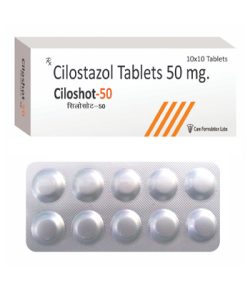
- Administered orally as a film-coated tablet (commonly 100 mg; 50 mg tablets are also available).
- The onset of symptomatic effect is gradual — some patients notice improvement in weeks, with up to 12 weeks often required for full benefit.
- Duration of benefit is maintained with continued long-term use; treatment is typically reviewed periodically and discontinued if no benefit after about 3 months.
- Avoid or limit alcohol while taking cilostazol, as alcohol can worsen dizziness, tachycardia, and other side effects.
- The most common side effect is headache (other frequent effects include diarrhea, palpitations, dizziness, peripheral edema, nausea, and mild tachycardia).
- Would you like to try “cilostazol” without a prescription?
Basic Cilostazol Information
- INN (International Nonproprietary Name): Cilostazol
- Brand Names Available In United States: Pletal
- ATC Code: B01AC23
- Forms & Dosages: Film-coated tablets, typically 100 mg and 50 mg strengths; common blister pack sizes include 10, 14, 30, 56, 60, 100.
- Manufacturers In United States: Not Specified
- Registration Status In United States: FDA Approved As Pletal
- OTC / Rx Classification: Prescription Only (Rx)
Everyday Use & Best Practices
Morning Vs Evening Dosing
What time should I take my cilostazol dose to build a steady routine?
The standard adult dose is cilostazol 100 mg taken orally twice daily.
Take each dose at least 30 minutes before breakfast and 30 minutes before dinner for consistent absorption.
Pick two consistent times you can reliably repeat every day, for example 7:00 AM and 7:00 PM.
If you experience morning palpitations or dizziness, talk with your prescriber about small timing tweaks rather than skipping doses.
Do not double up doses if you miss one; follow the missed-dose rule below.
Taking With Or Without Meals
Should I take cilostazol with food or on an empty stomach?
Take cilostazol at least 30 minutes before meals to keep blood levels predictable.
Avoid taking the tablet immediately after a high-fat meal because food can alter absorption.
If you need to shift dosing times, keep the before-meal rule in mind to maintain consistent exposure.
Quick Daily Checklist
- Take cilostazol 100 mg twice daily, typically ≥30 minutes before breakfast and dinner.
- Pick repeatable times (example: 7:00 AM and 7:00 PM).
- If you feel palpitations or dizziness, call your prescriber before skipping or changing doses.
- Missed-dose rule: take as soon as remembered unless it is near the next dose; do not double dose.
- Store tablets in original blister/bottle and keep below 25°C (77°F).
Household Integration Tips
How do I make twice-daily pills part of everyday life?
Use a twice-daily pill reminder on your phone or a physical medication chart on the fridge.
Pair each dose with a routine action, such as pre-breakfast coffee or pre-dinner prep, to build habit.
Keep the tablets in their original blister or bottle until use and store them below 25°C.
If multiple caregivers are involved, label the medication chart clearly with dose times and a prescriber phone number.
Prefer using a printable dosing chart or medication app with alarms to track adherence.
Safety Priorities
Who Should Avoid It
Who must not take cilostazol?
Do not start cilostazol if you have congestive heart failure of any severity.
Avoid cilostazol with known allergy to the drug or any excipients.
Do not use cilostazol in active bleeding such as peptic ulcer or intracranial hemorrhage.
Severe hepatic impairment is an absolute contraindication because the drug can accumulate.
Severe renal impairment is an absolute contraindication.
Pregnancy is an absolute contraindication to starting cilostazol.
Activities To Limit
What should I avoid while taking cilostazol?
Avoid driving or operating heavy machinery until you know how cilostazol affects you because headache, dizziness, and palpitations are common.
Avoid strenuous contact sports if you are also on antiplatelet or anticoagulant therapy because bleeding risk may increase.
If you have a history of arrhythmia, ischemic heart disease, uncontrolled hypertension, or bleeding disorders, discuss risks with your clinician.
Contraindications Table
| Absolute Contraindications | Relative Contraindications |
|---|---|
|
|
Pre-Start Screening Checklist
- Confirm no history of congestive heart failure.
- Check liver and kidney function; do not start for moderate/severe hepatic impairment or severe renal impairment.
- Ask about bleeding history, recent strokes, or peptic ulcer disease.
- Review current medications for antiplatelet or anticoagulant overlap.
- Discuss pregnancy risk if applicable.
Dosage & Adjustments
General Regimen
What dose should most adults follow?
The standard adult regimen is cilostazol 100 mg taken orally twice daily.
Each dose should be taken at least 30 minutes before breakfast and at least 30 minutes before dinner.
Expect a gradual onset of benefit over weeks, with full improvement sometimes taking up to 12 weeks.
If there is no meaningful improvement after about 3 months, consider discontinuation.
Missed-dose rule: take as soon as remembered unless it is near the next scheduled dose; do not double dose.
In case of overdose, seek immediate medical attention; watch for tachycardia, hypotension, and arrhythmias.
Special Cases
Do elderly patients need a different approach?
Elderly patients generally do not require an initial dose change, but monitor for increased sensitivity and comorbidities.
Hepatic impairment: cilostazol is contraindicated in moderate and severe hepatic disease due to accumulation risk.
Renal impairment: use with caution in mild to moderate impairment; severe impairment is not recommended.
Children: safety and efficacy are not established; do not use in pediatric patients.
Quick-Reference Table For Special Cases
| Patient Group | Guidance |
|---|---|
| Elderly | No routine dose reduction; monitor closely for side effects and interactions. |
| Moderate/Severe Hepatic Impairment | Contraindicated; do not start. |
| Mild/Moderate Renal Impairment | Use with caution; monitor renal function and side effects. |
| Severe Renal Impairment | Not recommended. |
| Children | Not recommended; safety and efficacy not established. |
When To Call Your Provider
- New or worsening palpitations or dizziness.
- Signs of major bleeding such as unexpected bruising or blood in stool or urine.
- Persistent severe headache or fainting spells.
- No improvement in walking distance after 12 weeks.
- Symptoms after a missed or extra dose that concern you.
User Testimonials
Positive Reports
What improvements do people notice on cilostazol?
Many users report improved walking distance and less leg cramp or claudication pain after several weeks.
Typical reports describe a “slow but real” benefit that becomes noticeable between 4 and 12 weeks.
Positive examples include being able to walk to the corner store without stopping and climbing a flight of stairs with less pain.
Some patients report better stamina for light activities such as gardening or short errands.
Common Challenges
What problems do people commonly face?
Early adverse effects such as headache, diarrhea, palpitations, dizziness, and mild tachycardia are common and may lead to stopping the drug.
Some users find they need to tweak the timing of doses because of palpitations or sleep disturbance.
Cost and prescription access are frequent hurdles, with insurance coverage varying.
What To Expect Timeline
- Weeks 1–4: Possible side effects like headache, dizziness, palpitations; begin to notice small increases in walking tolerance.
- Weeks 4–12: Gradual functional improvement in pain-free and maximal walking distance for many patients.
Side Effects That Merit Contacting Clinician
- Persistent or severe palpitations.
- Syncope or near-syncope.
- Major bleeding or signs of internal bleeding.
- Severe, persistent headache unresponsive to simple measures.
Buying Guide
Pharmacy Sources
Where can you get cilostazol in the United States?
Cilostazol is prescription-only in the United States and must be dispensed by a licensed pharmacy with a valid prescription.
Brand name Pletal and multiple generics are commonly available in 100 mg tablet strengths.
When choosing an online pharmacy, use licensed and verifiable sources and require a valid US prescription for safety.
In our online pharmacy, cilostazol is available without a prescription, with discreet delivery to United States in 5-14 days.
Price Comparison
How do prices vary?
Costs vary by brand, insurer, and pharmacy; generic cilostazol is usually less expensive than branded Pletal.
Packaging sizes and tablet strengths may differ by manufacturer and country; plan ahead when traveling.
Brand Vs Generic Table
| Product | Common Pack Sizes | Notes |
|---|---|---|
| Pletal (Brand) | 100 mg tablets; bottles or blisters (varies) | FDA approved brand in US; typically higher cost. |
| Generic Cilostazol | 50 mg and 100 mg tablets; blisters (10–100) | Lower cost options; equivalent active ingredient. |
What’s Inside & How It Works
Ingredients Overview
What formulation is cilostazol sold in?
Active ingredient: cilostazol in film-coated tablets at 100 mg and 50 mg strengths.
Excipients vary by manufacturer and are listed on the package leaflet.
No injectable, topical, or other nonoral forms are marketed for cilostazol; tablets are the available form.
Mechanism Basics
How does cilostazol help leg pain from PAD?
Cilostazol is a phosphodiesterase III inhibitor that increases cyclic AMP in platelets and vascular smooth muscle.
The result is reduced platelet aggregation and vasodilation, which helps blood flow to the legs and reduces symptoms of intermittent claudication.
It is not a treatment for acute ischemia or a standalone stroke prevention strategy.
Ingredient / Effect Summary
| Ingredient / Form | Mechanistic Effect |
|---|---|
| Cilostazol 100 mg Tablet | Increases cAMP → antiplatelet effect + vasodilation → improves walking distance in PAD |
Main Indications
Approved Uses
What is cilostazol approved to treat?
Cilostazol (Pletal) is approved for alleviating walking disability due to intermittent claudication in peripheral arterial disease.
The clinical goal is to increase pain-free and maximal walking distance using cilostazol 100 mg twice daily taken before breakfast and dinner.
It is not intended for acute ischemic events.
Off-Label Uses
Are there other uses clinicians sometimes try?
Clinicians may consider cilostazol in other circulatory or microvascular complaints, but evidence and approvals differ.
Always confirm off-label use with your prescriber and rely on published trial data and specialty guidance.
Assess treatment response within up to 12 weeks and discontinue if no improvement after about 3 months.
Approved Vs Off-Label Checklist
- Approved: Intermittent claudication due to PAD; cilostazol 100 mg twice daily.
- Off-label: Occasional circulatory or microvascular indications—discuss risk vs benefit with prescriber.
- Always set measurable walking goals and reassess at ~12 weeks.
Interaction Warnings
Food Interactions
Does food affect cilostazol?
Take cilostazol at least 30 minutes before meals to maintain predictable absorption.
High-fat meals may alter absorption, so stick to prescribed timing.
Drug Conflicts
Which medicines interact with cilostazol?
Cilostazol is metabolized by liver enzymes, so strong CYP3A4 or CYP2C19 inhibitors can raise cilostazol levels and increase side effects.
Examples include certain azole antifungals and some macrolide antibiotics; consult your prescriber or pharmacist before starting these drugs.
Concurrent use with multiple antiplatelet or anticoagulant agents increases bleeding risk and requires close monitoring.
Do not start new prescription or nonprescription medications, including supplements, without checking for interactions.
High-Risk Co-Medications To Review
- Strong CYP3A4 inhibitors (e.g., some azole antifungals).
- Strong CYP2C19 inhibitors.
- Multiple antiplatelets or any anticoagulant therapy.
- New macrolide antibiotics—check with prescriber.
Latest Evidence & Insights
Key Trial Takeaways
What do trials show about cilostazol?
Randomized trials and systematic reviews show cilostazol improves walking distance and functional outcomes for intermittent claudication versus placebo.
Benefits develop over weeks to months, often up to 12 weeks for the full effect.
Safety monitoring in trials highlighted cardiovascular concerns in patients with heart failure, which is why heart failure is an absolute contraindication.
Practical Clinical Tips
How do clinicians use cilostazol effectively?
Set measurable walking goals and perform a baseline walking test such as a treadmill or standardized walk test before starting therapy.
Check tolerability by phone or clinic within 2–4 weeks, and complete a formal functional reassessment at about 12 weeks.
Monitor pulse and blood pressure and watch for persistent palpitations or severe headaches.
Review all medications for CYP interactions and antiplatelet overlap before and during treatment.
Alternative Choices
Comparable Medications
What other drugs are considered for claudication?
Options include pentoxifylline, clopidogrel, dipyridamole, and ticlopidine depending on goals and comorbidities.
Each alternative has different mechanisms, benefits, and side-effect profiles.
Cilostazol’s combined vasodilator and antiplatelet effects often provide superior walking improvement versus some comparators, but individual suitability varies.
Comparison Table
| Drug | Mechanism | Pros / Cons |
|---|---|---|
| Pentoxifylline | Hemorheologic agent | Improves blood flow properties; smaller efficacy vs cilostazol for walking distance. |
| Clopidogrel | ADP receptor antiplatelet | Useful for antiplatelet effect; not primarily a vasodilator. |
| Dipyridamole | Antiplatelet and vasodilator | Alternative with different side-effect profile. |
Non-Drug Options
What lifestyle approaches help peripheral arterial disease?
Supervised exercise therapy is a first-line nonpharmacologic treatment and pairs well with pharmacotherapy.
Smoking cessation, lipid and blood pressure control, and diabetes management are essential.
Revascularization is an option for selected patients when conservative measures do not provide sufficient benefit.
Regulation Snapshot
Approval Status By Region
Where is cilostazol approved?
Cilostazol is approved in the United States (FDA as Pletal) and by major agencies including EMA, Health Canada, and TGA in Australia.
It is prescription-only in these regions.
Prescription & Packaging Notes
What should travelers know about packaging?
Packaging and brand names vary by country, but 100 mg tablets in blister packs are common worldwide.
Some markets also offer 50 mg strengths and different pack sizes.
Keep original packaging for identification and regulatory checks when traveling.
| Country | Common Brand | Typical Packaging |
|---|---|---|
| United States | Pletal | 100 mg tablets; bottles or blisters |
| Canada | Pletal | 100 mg tablets; bottles or blisters |
| United Kingdom | Pletal, Cilostazol | 100 mg tablets; blister packs (56 or 112) |
| Australia | Pletal | 100 mg tablets; bottle 56 |
| European Union | Pletal, Cilostazol (generics) | 100 mg tablets; blisters |
FAQ Section
Common Patient Questions
How long before I see benefit?
Effects are gradual and can appear from weeks up to 12 weeks; reassess by approximately 3 months and stop if there is no benefit.
Can I take cilostazol with other blood thinners?
Use caution; combined antiplatelet/anticoagulant therapy increases bleeding risk and should be managed by your prescriber.
Is cilostazol safe in heart failure?
No; congestive heart failure of any severity is an absolute contraindication.
What if I miss a dose?
Take the missed dose when you remember unless it is close to the next dose; do not double the dose.
How should I store cilostazol?
Store below 25°C (77°F) and keep in original packaging to protect from moisture and light.
Guidelines For Proper Use
Practical Start-To-Finish Checklist
- Confirm indication: intermittent claudication due to PAD.
- Screen for absolute contraindications: CHF, severe hepatic/renal impairment, active bleeding, pregnancy, allergy.
- Obtain baseline measures: pulse, blood pressure, and walking distance test.
- Prescribe cilostazol 100 mg twice daily, ≥30 minutes before breakfast and dinner.
- Counsel on common side effects, missed-dose instructions, and storage below 25°C.
Monitoring & Follow-Up
What monitoring should patients expect?
Check tolerability within 2–4 weeks by phone or clinic.
Perform a functional reassessment at approximately 12 weeks to judge benefit.
Discontinue if there is no meaningful improvement after about 3 months.
Advise immediate care for signs of arrhythmia, severe hypotension, or major bleeding.
Delivery Across United States
| City | Region | Delivery time |
|---|---|---|
| New York | New York | 5-7 days |
| Los Angeles | California | 5-7 days |
| Chicago | Illinois | 5-7 days |
| Houston | Texas | 5-7 days |
| Phoenix | Arizona | 5-7 days |
| Philadelphia | Pennsylvania | 5-7 days |
| San Antonio | Texas | 5-7 days |
| San Diego | California | 5-9 days |
| Dallas | Texas | 5-9 days |
| San Jose | California | 5-9 days |
| Austin | Texas | 5-9 days |
| Jacksonville | Florida | 5-9 days |
| Fort Worth | Texas | 5-9 days |
| Columbus | Ohio | 5-9 days |