Imiquimod
In brief
- You may be able to buy imiquimod from some online pharmacies and marketplaces, but in major countries it is generally a prescription-only medicine (Rx). Availability varies by country and local regulation.
- Imiquimod is used for actinic keratosis, superficial basal cell carcinoma, and external genital/perianal warts. It is an immune response modifier that stimulates local production of interferons and cytokines to help the body fight abnormal or virus-infected skin cells.
- The usual dose depends on the condition: for actinic keratosis, apply a thin layer 2 times per week; for superficial basal cell carcinoma, 5 times per week; and for external genital/perianal warts, 3 times per week on alternate days. Follow the prescribed treatment plan.
- The form of administration is topical cream, most commonly 5% or 3.75%, applied directly to the affected skin area.
- Imiquimod does not work immediately; local skin reactions may begin within days, but visible therapeutic improvement is usually seen over several weeks.
- The duration of action is prolonged with repeated topical use, and treatment courses commonly last from 6 weeks to 16 weeks depending on the indication.
- Alcohol is not known to have a direct interaction with topical imiquimod, but excessive drinking may worsen skin irritation or interfere with healing. Use caution.
- The most common side effects are local skin reactions such as redness, itching, burning, swelling, flaking, scabbing, and pain; headache and flu-like symptoms can also occur.
- Would you like to try imiquimod without a prescription?
Basic Imiquimod Information
- INN (International Nonproprietary Name): Imiquimod.
- Brand names available in United States: Aldara, Zyclara.
- ATC Code: D06BB10.
- Forms & dosages: Cream, 5% (50 mg/g, 12.5 mg/250 mg) topical in sachets; cream, 3.75% topical in tubes or sachets.
- Manufacturers in United States: Bausch Health, Viatris, Graceway Pharmaceuticals, Cosette, Fougera Pharms, Taro, Padagis Israel.
- Registration status in United States: Prescription-only.
- OTC / Rx classification: Prescription-only in all major territories.
How Imiquimod Fits Into Daily Use
Morning Vs. Evening Dosing
People usually want to know one simple thing first: does imiquimod fit around a normal workday?
Because imiquimod is a topical prescription medicine, it is applied on a schedule rather than around meals.
For day-to-day life, many people find night dosing easier because the cream needs to stay on the skin for several hours, often about 8 hours, depending on the indication.
That makes bedtime application practical for actinic keratosis, superficial basal cell carcinoma, and genital or perianal warts.
Typical adult schedules are different by condition.
Actinic keratosis is usually treated 2 times per week.
Superficial basal cell carcinoma is often treated 5 times per week.
External genital or perianal warts are commonly treated 3 times per week on alternate days.
Before applying:
- Wash your hands.
- Clean and fully dry the target area.
- Check that the skin is intact and not irritated beyond what your clinician expected.
- Apply only a thin layer.
- Plan for the full leave-on time before bathing or showering.
Taking With Or Without Meals
Food does not affect topical application the way it does with oral medicines.
The real timing issue is skin care, not breakfast or dinner.
After application, avoid washing the area too soon, because the medicine needs contact time to work as prescribed.
That same routine applies whether a patient is using imiquimod cream, an Aldara sachet, or Zyclara cream.
At home, storage is straightforward: keep it at room temperature, 15 to 25 degrees Celsius, do not freeze it, and keep sachets sealed until use.
When patients ask about nightly application, the answer is usually yes for convenience, as long as the prescribed schedule is followed exactly.
Safety Priorities
Who Should Avoid It
The main absolute contraindication is known hypersensitivity to imiquimod or any excipient in the product.
It should also be avoided on broken or ulcerated skin and on mucous membranes.
That matters in real life because irritation can make the treated area much more sensitive than expected.
People with autoimmune disorders, severe inflammatory dermatologic disease, or a history of organ transplantation need specialist advice before use because the immune-stimulating effect can be a problem.
Pediatric use is limited, and it is generally not recommended under 12 years except in special cases.
| Situation | Practical Advice |
|---|---|
| Avoid use | Known allergy to imiquimod, broken skin, ulcerated skin, mucous membranes |
| Use only with specialist advice | Autoimmune disorders, severe inflammatory skin disease, organ transplant recipients, children under 12 in special cases |
Activities To Limit
Daily routines can become uncomfortable if the skin is reacting strongly, so a few common-sense limits help.
Do not use occlusive dressings unless the prescriber tells you to.
Do not wash the area too soon after applying the cream.
If treatment is for genital warts, avoid sex during application windows if irritation is present.
Common local skin reactions include redness, erosion, scabbing, itching, burning, and pain.
Less common systemic symptoms can include headache, flu-like symptoms, myalgia, and fatigue.
Those effects are the main reasons to contact a clinician if the reaction feels more than expected.
Dosage And Adjustments
General Regimen
People often want the schedule written out in plain English so there is no guesswork.
That is especially true when the box says imiquimod dosage and the patient is trying to match it to actinic keratosis treatment or genital wart regimen.
| Condition | Frequency | Leave-On Time | Duration |
|---|---|---|---|
| Actinic keratosis | 2 times per week | About 8 hours | 16 weeks |
| Superficial basal cell carcinoma | 5 times per week | About 8 hours | 6 weeks |
| External genital or perianal warts | 3 times per week on alternate days | 6 to 10 hours | Up to 16 weeks |
The key point is to apply a thin layer and stay with the prescribed schedule.
Using more cream or using it more often does not mean better results.
Special Cases
No routine dose adjustment is needed for older adults.
For renal or hepatic impairment, no established adjustment exists, but caution and monitoring are still recommended.
If a dose is missed, apply it as soon as remembered unless it is close to the next scheduled dose.
Topical overdose is not commonly described; if too much is used, wash the area thoroughly and seek medical advice if symptoms develop.
For patients comparing actinic keratosis treatment options or a superficial basal cell carcinoma schedule, the prescribed regimen is the part that matters most.
User Experiences
Positive Reports
Many patients like the fact that treatment happens at home and does not require office procedures every single time.
That privacy matters, especially for visible lesions or genital wart treatment.
Structured dosing can also feel manageable because the routine is predictable.
People shopping for imiquimod cream results often want to know how fast it works, but response time varies by condition and by how closely the schedule is followed.
- Convenient at-home use.
- Prescription-based routine with clear instructions.
- More privacy than repeated in-office treatment for some patients.
Common Challenges
Local redness, burning, peeling, scabbing, and soreness can make ordinary activities uncomfortable.
That can affect sleep, clothing choices, and intimacy during genital wart treatment.
Some patients find the irritation worse than they expected, even when the treatment is working as intended.
Those practical issues are a big part of real-world imiquimod experience and are also reflected in Aldara reviews and other topical therapy feedback.
Buying Guide
Pharmacy Sources
In major territories, imiquimod is prescription-only, including the US, Canada, and EU markets.
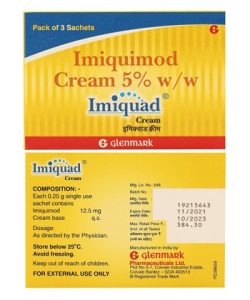
Brand names vary by country, and packaging can also differ, which is why patients searching for imiquimod cream buy or imiquod packaging should always match the product to the prescribed strength.
| Brand | Strength | Region |
|---|---|---|
| Aldara | 5% | US, EU, UK, Canada |
| Zyclara | 3.75% | US, EU |
| Imiquad | 5% | India |
| Beselna | 5% | Japan |
Packaging may be in single-use sachets for 5% cream or in tubes and sachets for 3.75% cream.
Price Comparison
Price comparison is most useful when patients look at brand, strength, quantity, and whether the medicine comes in sachets or tubes.
Insurance coverage and pharmacy substitution rules can change the final cost.
Common search terms include Aldara price, Zyclara price, and imiquimod cream buy, especially when comparing strengths or package sizes.
In our online pharmacy, imiquimod is available without a prescription, with discreet delivery to United States in 5-14 days.
What Is Inside And How It Works
Ingredients Overview
The INN is imiquimod, and it is also recognized by JAN and USP under the same name.
It is a topical cream formulation, most commonly 5% or 3.75%.
Excipients vary by brand and manufacturer.
| Strength | Common Packaging | Route |
|---|---|---|
| 5% | Single-use sachets or multi-pack sachets | Topical |
| 3.75% | Tubes or sachets | Topical |
Mechanism Basics
Imiquimod is an immune response modifier.
It helps induce interferon and cytokines, which boosts local immune activity against abnormal or virus-infected cells.
That immune effect is why it is used for actinic keratosis, superficial basal cell carcinoma, and genital or perianal warts.
For most patients, the useful takeaway is simple: it works by encouraging the skin’s local immune response rather than by directly killing cells in the way some other creams do.
Main Indications
Approved Uses
The main adult indications are actinic keratosis, superficial basal cell carcinoma, and external genital or perianal warts.
It is prescription-only and classified under ATC code D06BB10.
| Indication | Frequency | Duration |
|---|---|---|
| Actinic keratosis | 2 times per week | 16 weeks |
| Superficial basal cell carcinoma | 5 times per week | 6 weeks |
| External genital or perianal warts | 3 times per week on alternate days | Up to 16 weeks |
Off-Label Uses
Some clinicians may use imiquimod outside approved indications, but that should be specialist-led and based on local guidance.
The product label still matters most, especially for children under 12, where use is generally not recommended except in special cases.
That is why terms like Aldara for skin cancer or Zyclara for actinic keratosis should always be checked against the exact approved regimen.
Interaction Warnings
Food Interactions
Food interactions are not relevant because imiquimod is applied topically.
Meal timing does not affect absorption in the same way as oral medicines.
Drug Conflicts
The bigger concern is using other topical products that may irritate the same skin area.
Other inflammatory skin treatments can make redness and burning worse.
Patients should tell a clinician about autoimmune disease, transplant history, and severe skin conditions before starting therapy.
No established renal or hepatic dose adjustment exists, but caution is still needed.
Latest Evidence And Insights
What Current References Show
The most reliable references are regulatory and public sources such as the EMA product information, US DailyMed, Health Canada, and local agencies like ANMDMR.
Aldara has been authorized in the EU since 1998, with renewals in 2003 and 2008.
There are more than 11 US NDAs, and the product is manufactured globally by multiple suppliers.
- Approved schedules remain the same in core references.
- Local skin reactions remain the main practical issue.
- Regulatory labeling continues to guide routine use.
What Patients Should Know
There is no dramatic new twist here for most patients.
Approved dosing and local irritation are still the central realities.
That is why DailyMed imiquimod entries and EMA Aldara documents stay useful for everyday decisions.
Alternative Choices
When Alternatives May Be Used
Different lesions call for different tools, and sometimes a clinician may prefer another option based on location, tolerance, or convenience.
| Option | Best Use Case | Main Limitation |
|---|---|---|
| Podophyllotoxin topical | Genital warts | Different schedule and local irritation |
| 5-Fluorouracil cream | Actinic keratosis and superficial skin cancers | Can also be irritating |
| Cryotherapy | Actinic keratosis and warts | Office procedure, not home cream use |
| Ingenol mebutate | Actinic keratosis in some older references | Withdrawn in some markets |
Convenience, irritation, and lesion type are the everyday decision points.
How To Discuss Options With A Clinician
Ask about lesion location, expected treatment duration, and how much irritation is normal.
Prescription access and country-specific availability also vary by brand, which is why a pharmacy listing may not look the same from one region to another.
Those same questions come up often when patients compare imiquimod alternatives, podophyllotoxin, 5-fluorouracil cream, or cryotherapy.
Regulation Snapshot
US And International Status
Imiquimod is prescription-only in major territories.
FDA prescription status, EMA authorization for Aldara, Canadian Rx-only status, and listings in European regulatory agencies all point in the same direction.
It carries ATC code D06BB10 and appears under many brand names worldwide.
| Region | Brand | Status |
|---|---|---|
| United States | Aldara, Zyclara | Prescription only |
| European Union | Aldara | Authorized |
| Canada | Aldara | Prescription only |
| Romania | Imiquimod listings in agency databases | Regulatory database listing |
What This Means For Patients
Availability and packaging may differ by country, including sachets and tubes.
Checking local pharmacy listings and national regulatory databases is the safest way to confirm what is sold where.
Imiquimod FAQ
Common Questions
How long does imiquimod stay on the skin? For actinic keratosis and superficial basal cell carcinoma, it is typically left on about 8 hours.
Can I wash it off early? It should stay on for the prescribed leave-on time unless your clinician tells you otherwise.
What if I miss a dose? Apply it when remembered unless it is close to the next scheduled dose.
Is redness normal? Yes, local redness is common, along with burning, itching, and scabbing.
When To Call A Clinician
Get medical advice if there is severe pain, spreading sores, feverish flu-like symptoms, or signs of an allergic reaction.
Worsening irritation may mean the dose needs review.
Guidelines For Proper Use
Step-By-Step Application
The best results come from a simple routine that is followed the same way each time.
- Wash your hands and the target skin area.
- Dry the area completely.
- Apply a thin layer of cream.
- Leave it on for the prescribed time.
- Wash it off with mild soap and water.
- Wash your hands again.
Do not apply it on mucous membranes or broken skin unless a specialist specifically instructs otherwise.
Storage, Missed Dose, And Follow-Up
Store imiquimod at 15 to 25 degrees Celsius, avoid freezing, protect it from excessive heat, and keep sachets sealed until use.
If a dose is missed, apply it when remembered unless the next dose is close.
Follow-up matters because response and irritation need monitoring, especially when treatment is used for several weeks.
Adolescents and older adults may need individualized guidance, and children under 12 are generally not candidates.
Delivery Across United States
| City | Region | Delivery time |
|---|---|---|
| New York | Northeast | 5-7 days |
| Los Angeles | West | 5-7 days |
| Chicago | Midwest | 5-7 days |
| Houston | South | 5-7 days |
| Phoenix | West | 5-7 days |
| Philadelphia | Northeast | 5-7 days |
| San Antonio | South | 5-9 days |
| San Diego | West | 5-7 days |
| Dallas | South | 5-7 days |
| San Jose | West | 5-9 days |
| Austin | South | 5-7 days |
| Jacksonville | South | 5-9 days |
| Fort Worth | South | 5-9 days |
| Columbus | Midwest | 5-9 days |