Colchicine
In brief
- Colchicine can be purchased in some pharmacies and online pharmacies, and it is prescription-only in most jurisdictions; however, availability without a prescription may vary by seller and country.
- Colchicine is used for the treatment and prevention of gout flares, familial Mediterranean fever, and sometimes pericarditis. It works by reducing inflammation, especially by inhibiting microtubule polymerization and neutrophil activity.
- The usual dose depends on the condition: for an acute gout flare, 1.2 mg at the first sign followed by 0.6 mg one hour later; for prevention, 0.6 mg once or twice daily; for familial Mediterranean fever, about 1.2–2.4 mg/day in divided doses.
- Colchicine is taken by mouth as tablets or, rarely, as an oral solution.
- The effect of colchicine typically begins within about 1 to 2 hours, with symptom relief often developing over the same day.
- The duration of action is several hours, and for gout flare treatment it should not usually be repeated within 3 days.
- Alcohol should be avoided or limited, because it can worsen gout and may increase stomach upset and dehydration.
- The most common side effects are diarrhea, nausea, abdominal pain, and vomiting.
- Would you like to try colchicine without a prescription?
Basic Colchicine Information
- INN (International Nonproprietary Name): Colchicine
- Brand names available in United States: Mitigare, Colcrys
- ATC Code: M04AC01
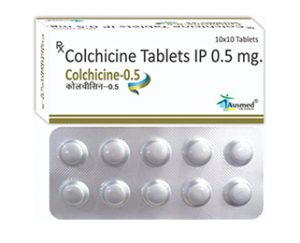
- Forms & dosages: Tablets 0.5 mg, 0.6 mg, 1 mg; rare oral solution 0.5 mg/5 mL
- Manufacturers in United States: Hikma, Takeda, Prasco
- Registration status in United States: US FDA prescription-only, approved for gout and Familial Mediterranean Fever (FMF)
- OTC / Rx classification: Prescription medication (Rx) in all jurisdictions
Everyday Use & Best Practices
Can colchicine fit into a real life routine without confusion?
Yes, but only when the prescription is followed exactly as written.
Colchicine tablets are prescription-only, and the timing depends on the condition being treated.
For gout prevention, many patients do best with once-daily or twice-daily dosing that can be tied to an everyday habit, like breakfast and bedtime.
For an acute gout flare, the usual day-1 split regimen is 1.2 mg at the first sign of symptoms, then 0.6 mg one hour later, with no repeat course within 3 days.
Some people take a colchicine pill with food to ease stomach upset, but the label and prescriber instructions always come first.
That matters because colchicine side effects often show up in the gut before anything else.
- Set a phone reminder for each dose.
- Keep the tablets in the original container.
- Take the dose at the same time each day when possible.
- Do not use “catch-up” doses after a missed dose.
Missed-dose warning: If a dose is missed, take it as soon as remembered unless the next dose is close.
Never double up, because that can quickly push the dose into unsafe territory.
Safety Priorities
Who needs to be extra careful with this prescription medication?
People with severe renal impairment, severe hepatic impairment, known hypersensitivity, or a need for strong CYP3A4 inhibitors or P-gp inhibitors should not use colchicine unless a clinician specifically says it is appropriate.
Older adults, patients with kidney or liver disease, and people with gastrointestinal disease need closer monitoring because colchicine warnings are most important when the body clears the drug more slowly.
Stop and call a clinician if these symptoms occur:
- Severe diarrhea or repeated vomiting.
- Unusual fatigue or weakness.
- Muscle pain or rash.
- Dizziness that makes driving unsafe.
Daily life safety matters too.
Avoid driving, ladders, or strenuous activity if dizziness, fatigue, vomiting, or weakness starts after taking colchicine.
Overdose can be fatal, so never share the medicine and never take extra doses “just in case.”
Pregnancy and breastfeeding require individualized risk and benefit assessment, especially when colchicine side effects or interaction concerns are already present.
Dosage & Adjustments
How much colchicine is used depends on why it was prescribed.
For an acute gout flare, the practical adult regimen is 1.2 mg at the first sign, then 0.6 mg one hour later, with a maximum of 1.8 mg in 24 hours.
For gout prevention, the common adult dose is 0.6 mg once or twice daily.
For FMF, the typical range is 1.2 mg to 2.4 mg per day in divided doses.
For pericarditis, the usual dose is 0.5 mg to 0.6 mg once or twice daily, often with NSAIDs.
| Condition | Typical Adult Regimen | Practical Note |
|---|---|---|
| Acute gout flare | 1.2 mg, then 0.6 mg one hour later | Do not repeat within 3 days |
| Gout prevention | 0.6 mg once or twice daily | Usually re-evaluated after 3 to 6 months |
| Familial Mediterranean Fever | 1.2 mg to 2.4 mg/day in divided doses | May be lifelong |
| Pericarditis | 0.5 mg to 0.6 mg once or twice daily | Often combined with NSAIDs |
Special cases need dose changes.
Children age 4 and older with FMF may start at 0.3 mg to 0.6 mg daily and then be titrated.
Elderly patients often need a lower starting dose.
Mild to moderate renal impairment or hepatic impairment usually means a lower dose, while severe kidney or liver disease may mean avoiding colchicine altogether.
A quick checklist helps before any dose change: kidney function, liver function, age, other medicines, and how long prophylaxis has already been used.
User Testimonials
What do people usually notice first after starting colchicine?
Many describe fewer gout flares, faster relief when the medicine is taken early, and the convenience of a small oral tablet.
- What people notice most: fewer attacks over time.
- What people notice most: a simple tablet format that is easy to carry.
- What people notice most: faster symptom control when acute dosing is started right away.
What bothers people most?
Diarrhea, nausea, and abdominal pain are the most common reasons patients stop or reduce use.
Some also say the interaction rules and dose limits make colchicine feel hard to manage, especially when they are already taking several prescriptions.
Mitigare colchicine, Colcrys, and other colchicine tablet brand names can be familiar to long-term users, but the same safety rules still apply across brands.
Buying Guide
Where do patients usually get colchicine in the United States?
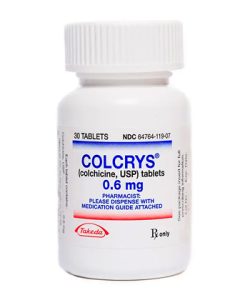
Colchicine is Rx-only in the U.S. and is commonly sold as Mitigare and Colcrys in 0.6 mg tablet form.
Depending on the pharmacy and insurance plan, brand and generic availability can vary.
| Product Type | Common Form | Packaging |
|---|---|---|
| Colcrys | 0.6 mg tablets | Blister packs or bottles |
| Mitigare | 0.6 mg capsules or tablets, depending on market listing | Pharmacy-specific packaging |
| Generic colchicine | 0.6 mg tablets | Bottles or blister packs |
Colcrys price can vary a lot based on brand, generic selection, pack size, and pharmacy discounts.
Before filling, check formulary coverage and ask the pharmacist about equivalent authorized generics.
In our online pharmacy, colchicine is available without a prescription, with discreet delivery to United States in 5-14 days.
What’s Inside & How It Works
What exactly is in a colchicine tablet?
The INN is colchicine, and the medication is classified as an antigout agent under ATC code M04AC01.
International dosage forms include tablets at 0.5 mg, 0.6 mg, and 1 mg, plus a rare oral solution at 0.5 mg/5 mL.
Packaging is commonly blisters or bottles, depending on the market.
| Formulation | Strengths | Common Packaging |
|---|---|---|
| Tablets | 0.5 mg, 0.6 mg, 1 mg | Blister packs or bottles |
| Oral solution | 0.5 mg/5 mL | Bottle |
How it helps is straightforward.
Colchicine does not lower uric acid.
Its main role is calming inflammation, which is why it helps during gout flares and in Familial Mediterranean Fever.
Quick summary: Colchicine reduces inflammatory symptoms rather than treating the uric acid cause directly.
Main Indications
What is colchicine approved to treat in the United States?
The U.S. FDA-approved uses are gout and Familial Mediterranean Fever.
For gout, it may be used both for acute flares and for prevention.
For FMF, it is a cornerstone treatment that may be continued long term.
| Use | Status | Practical Note |
|---|---|---|
| Gout | Approved | Used for flare treatment and prevention |
| Familial Mediterranean Fever | Approved | Often long-term therapy |
| Pericarditis | Off-label in many countries | Use only if prescribed |
| Cardiovascular disease after MI | Studied as adjunct | Not a self-treatment option |
Pericarditis is a common off-label use in many countries, and colchicine for cardiovascular risk reduction has also been studied after myocardial infarction.
Those uses are not over-the-counter decisions.
Patients should use colchicine only for those purposes if a clinician prescribes it and explains the monitoring plan.
Interaction Warnings
Are food interactions the main issue with colchicine?
Usually not.
Food is not the biggest concern, but taking the dose with food can help some people who feel stomach upset.
The larger safety problem is drug interactions.
Strong CYP3A4 inhibitors and P-gp inhibitors can raise colchicine levels and make toxicity more likely.
| Interaction Type | Why It Matters | What To Do |
|---|---|---|
| Strong CYP3A4 inhibitors | Can increase colchicine exposure | Do not combine unless a clinician directs it |
| P-gp inhibitors | Can increase toxicity risk | Ask before use |
| OTC medicines and supplements | Can add hidden risk | Tell every clinician and pharmacist |
Colchicine warnings are especially important when a person starts a new prescription medication or sees multiple clinicians.
Always mention every prescription, over-the-counter medicine, and supplement before starting colchicine tablets.
Latest Evidence & Insights
Why does colchicine still matter after so many years?
It remains one of the oldest and most widely used gout medicines globally, with ongoing interest in FMF and cardiovascular studies.
- The newest evidence helps define who benefits most.
- It also helps decide who needs closer monitoring.
- It guides whether long-term use is worth the risk for a specific patient.
Colchicine for cardiovascular risk reduction continues to be studied, but the most practical value remains in gout and FMF care.
Generic colchicine dominates many markets outside North America and Western Europe, which is why packaging and tablet strengths may look different from country to country.
Alternative Choices
What if colchicine is not the best fit?
For gout, alternatives include allopurinol, febuxostat, and probenecid.
These are not direct substitutes for every situation because some lower uric acid and colchicine mainly reduces inflammation.
| Medication | Best For | Main Limitation | Requires Prescription |
|---|---|---|---|
| Allopurinol | Long-term uric acid control | Not for immediate flare relief | Yes |
| Febuxostat | Long-term uric acid control | Not for immediate flare relief | Yes |
| Probenecid | Uric acid elimination | Not an anti-inflammatory substitute | Yes |
| Colchicine | Inflammation control in gout and FMF | GI side effects and interaction limits | Yes |
The Probenecid and Colchicine combination, sometimes called Proben-C, is a different product than colchicine alone.
For FMF, NSAIDs and biologics may be used in resistant cases, but colchicine is often the foundation treatment.
Regulation Snapshot
Is colchicine regulated the same way everywhere?
Yes on one key point: it is prescription-only in all listed jurisdictions.
In the U.S., FDA-approved brands include Colcrys and Mitigare.
| Region | Common Brand Names | Status |
|---|---|---|
| United States | Colcrys, Mitigare | Prescription only |
| Canada | PMS-Colchicine, AG-Colchicine | Prescription only |
| Europe | Colchicine Opocalcium, Colchimax, Colchicine 1A Pharma | Prescription only |
| Australia/New Zealand | Colgout, Colchicine Juno | Prescription only |
Common forms include 0.5 mg, 0.6 mg, and 1 mg tablets in blisters or bottles.
Regional names such as Colchicine Opocalcium, Colchimax, and Colgout show how the same medicine is packaged differently around the world.
Frequently Asked Questions
How fast does colchicine work? For an acute gout flare, it works best when taken at the first sign of symptoms.
What if I miss a dose? Take it as soon as remembered unless the next dose is close, and never double the dose.
Can I take colchicine daily? Yes, if it is prescribed for gout prevention or FMF, but the dose and duration need regular review.
When should I call for help? Call urgently for severe diarrhea, vomiting, weakness, or any signs of overdose.
Why does diarrhea matter so much? Because it can be an early warning sign that the dose is too high or the medicine is not being tolerated well.
Why do kidney or liver disease changes matter? Because dose changes are often needed to reduce colchicine side effects and avoid toxicity.
Can overdose be serious? Yes, overdose is an emergency because colchicine toxicity can be fatal.
Guidelines For Proper Use
How should colchicine be stored at home or while traveling?
Store it at 15 to 30°C, or 59 to 86°F, away from moisture and light.
Keep the tablets in the original packaging, and transport them at controlled room temperature.
- Follow the prescribed regimen exactly.
- Do not double doses.
- Keep out of reach of children.
- Keep the tablets dry and protected from light.
- Seek emergency help for overdose symptoms such as severe GI distress or signs of multi-organ failure.
Duration depends on the indication.
Acute gout uses single or split dosing on day 1.
Prophylaxis is usually continuous daily therapy with re-evaluation at 3 to 6 months.
FMF often requires longer-term use, sometimes lifelong, as directed by the physician.
Delivery Across United States
| City | Region | Delivery Time |
|---|---|---|
| New York | Northeast | 5-7 days |
| Los Angeles | West | 5-7 days |
| Chicago | Midwest | 5-7 days |
| Houston | South | 5-7 days |
| Phoenix | West | 5-7 days |
| Philadelphia | Northeast | 5-7 days |
| San Antonio | South | 5-7 days |
| San Diego | West | 5-7 days |
| Dallas | South | 5-7 days |
| San Jose | West | 5-7 days |
| Austin | South | 5-7 days |
| Jacksonville | South | 5-9 days |
| Columbus | Midwest | 5-9 days |
| Fort Worth | South | 5-9 days |
| Indianapolis | Midwest | 5-9 days |